Data & privacyNote
Apple will check iCloud items shared by public link, from iOS 27.3
What Apple’s support note of 3 November says about checking iCloud items shared with “anyone with the link”, what was already not end-to-end encrypted, and how to share privately.

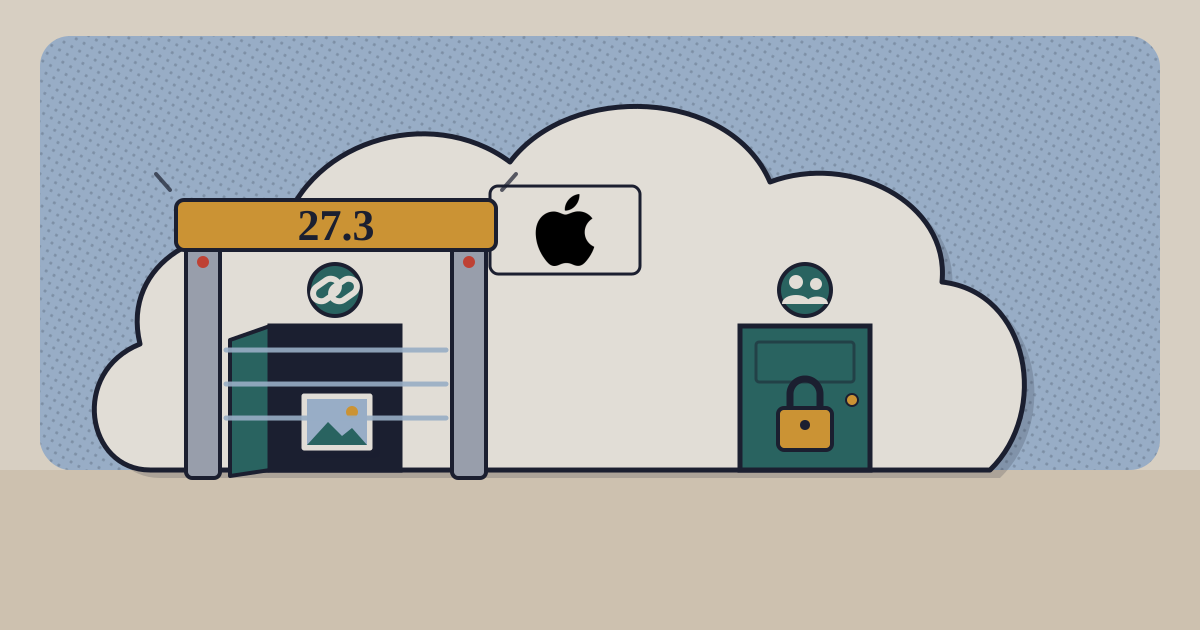
From version 27.3 of iOS, iPadOS, macOS and visionOS, anything shared from iCloud with “Anyone with the link” “will be checked by Apple for harmful content”, Apple says in a support document published on 3 November. Such an item “is no longer end-to-end encrypted, even if the owner or participants have turned on Advanced Data Protection”. If someone tries to upload harmful content, Apple may remove it, block or disable the Apple Account, stop a new account being created with the same email address or phone number, “or if necessary, involving law enforcement”.1
01What changes, and what Apple has not said
When you share a photo from iCloud Photos or a file from iCloud Drive, you can send a copy or share a link. A link goes either to “People you choose”, meaning only people you invite or approve, or to “Anyone with the link”, which, Apple writes, makes the item accessible to anyone who has the link, “including Apple”. The new check applies to the second.1
Apple does not define “harmful content”, say how the check is done, or say whether it covers items already shared by link before the update. The note adds that “not all features are available in all countries or regions”.1 The first 27.3 betas reached developers on 3 November, eight days after 27.2 was released on 26 October; Apple has not given a release date for 27.3.3
The iCloud terms, last revised on 14 September, already reserve Apple’s right to “screen, move, refuse, modify and/or remove Content at any time”, and say Apple has systems designed to limit how long “serious illegal content, including child sexual exploitation and abuse content” stays on the service, which “might include blocking functions and controls on sharing Content between users”.4
02The encryption part is not new
Apple’s iCloud security overview, published on 5 January, already said that iWork collaboration, Shared Albums in Photos and sharing with “anyone with the link” “do not support Advanced Data Protection”: the keys for such content are uploaded to Apple’s data centres so iCloud can run the web sharing.2 Advanced Data Protection is an optional setting that raises the number of end-to-end encrypted data categories from 15 to 25, adding iCloud Backup, iCloud Drive, Photos and Notes; with it on, shared content stays end-to-end encrypted “as long as all participants” have it on too, in iCloud Shared Photo Library, iCloud Drive shared folders, shared Notes and Freeform collaboration.2 Under the default setting, shared iCloud content is not end-to-end encrypted at all.2 What 27.3 adds is that Apple will now check what a public link exposes.
Apple will check what an open link exposes; invite-only sharing can stay end-to-end encrypted
Sharing an iCloud Photos or iCloud Drive item by link, as Apple describes each mode, from version 27.3
Anyone with the link
- Open to anyone who has the link, “including Apple”
- Checked by Apple for “harmful content” from version 27.3
- Not end-to-end encrypted, even with Advanced Data Protection on
- Flagged uploads: content removed, account disabled, police “if necessary”
People you choose
- Only people you invite or approve
- The 3 November note describes no check for this mode
- End-to-end encrypted when every participant has Advanced Data Protection on
- Under standard data protection, shared content is not end-to-end encrypted
Source: Apple support documents 149168 (3 Nov 2026) and 102651 (5 Jan 2026) · as of 6 November 2026 · Apple's note does not say how invite-only shares are treated by the check
Apple announced Advanced Data Protection on 7 December 2022.5 The same day it said it had “decided to not move forward with our previously proposed CSAM detection tool for iCloud Photos”, adding: “Children can be protected without companies combing through personal data” (Apple’s statement, as published by WIRED).6 The check Apple now describes applies to items their owner has opened to anyone with the link.
Sources
- Apple Support, Learn more about sharing content that can be accessed by Anyone with the Link (149168) — 3 November 2026
- Apple Support, iCloud data security overview (102651) — 5 January 2026
- Apple Developer, Software releases: iOS, iPadOS, macOS and visionOS 27.3 beta; iOS 27.2 — 3 November and 26 October 2026
- Apple, iCloud Terms and Conditions — last revised 14 September 2026
- Apple, press release: Apple advances user security with powerful new data protections — 7 December 2022
- WIRED, Apple Kills Its Plan to Scan Your Photos for CSAM. Here's What's Next (Apple's statement) — 7 December 2022
Disclosure. TechBag is a software reseller: it earns a margin when a reader buys through it, including from vendors named here. The analysis is TechBag’s own; no vendor paid for or saw this piece before publication. Facts are labelled reported, TechBag count or our view.
Keep reading