Birmingham’s Oracle ERP: £128m by March, against a £20m business case
Birmingham City Council’s Audit Committee report of 25 November: £128.1m spent or forecast on Oracle from 2018/19 to March 2027, what it includes, and the rebuilt system’s first months.

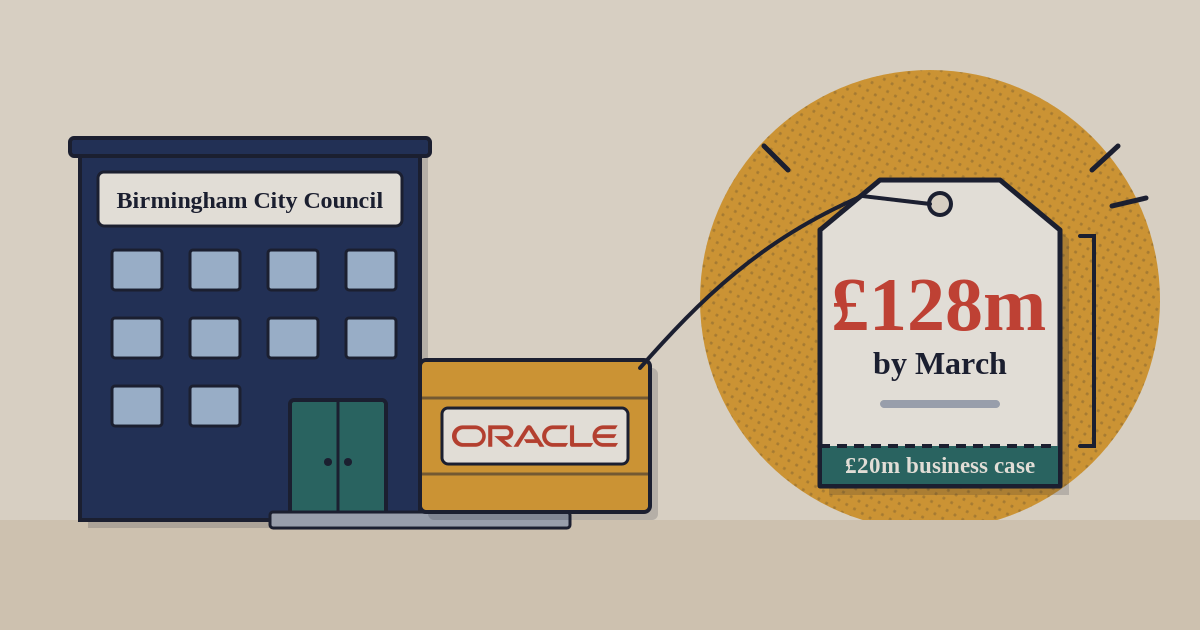
Birmingham City Council’s Oracle programme will have cost £128.1m by the end of March 2027, from its start in 2018/19, according to Table 1 of a report to the council’s Audit Committee on 25 November. The total is £63.4m of historic spending on the first implementation, £33.5m to re-implement Oracle, £34.2m for the live service and £2.5m for a new income-management system, less £5.5m of staff costs to be allocated back to council services. Funding over the same years comes to £156.9m.1 The 2019 business case put the project at £19.96m, The Register reports.2 The council asks readers not to set one figure against the other:
It is not valid to equate the total cost of the programme as shown in Table 1 with the cost of the initial implementation then re-implementation.
01What the £128.1m covers
The council’s reason: it “has borne the annual third party licencing and business support costs for ERP throughout the period from 2018–2019 to 2026–2027, and this is included in the amounts shown.” The report lists what the totals hold: designing, testing and deploying the first system, “which went live in April 2022 after delays and budget revisions”; trying to fix it; building the replacement; licences, staff and support; and extra resources to keep the first system going until the second was ready.1 The commissioners overseeing the council describe the three main lines as the first implementation “(including licence costs)”, running the first live system “(supporting and fixing it)” and the re-implementation.1 The report does not yet split the £63.4m between licences and project work: a financial reconciliation of all costs from 2019 to 2026 has begun, a more detailed breakdown will follow, and the council says it does not expect to find unrecorded spending.1
Birmingham’s Oracle programme: £128.1m to March 2027, against £20m in the 2019 business case
Birmingham City Council, Oracle (Brindley) programme: spending by line, 2018/19 to 2026/27 (2026/27 forecast), £ million
Source: Birmingham City Council, report to Audit Committee, 25 November 2026, Table 1; 2019 business case as reported by The Register · as of 28 November 2026, 7:00pm IST · The total is after £5.5m of staff costs to be allocated back to council services; Table 1 is dated October 2026
02What went wrong the first time
In June 2023, 14 months after go-live, the council said officers had moved from adopting Oracle, changing its own processes to fit, to adapting it: the system was “customised to meet the council’s existing business processes”. Payments to and from the council were being allocated to accounts by hand, the 2022/23 accounts could not be closed, and it put the cost of a full implementation at about £100m.3 On 5 September 2023 it issued a section 114 notice, under which all new spending except on vulnerable people and statutory services had to stop; its statement that day cited equal-pay claims of £650m to £760m and an in-year budget gap of about £87m, and did not mention Oracle.4 The government’s commissioners later wrote that “the disastrous implementation of Oracle” and the Perry Barr housing development had “each left the Council with an additional £150m debt”.5
03The second go-live, and what comes next
The rebuilt system, which the council calls Brindley, went live in August 2026. It has had no priority-one or “showstopper” issue in three payroll cycles and three month-ends, and three priority-two issues, one still open, over ending or extending fixed-term and contingent workers’ contracts. Open tickets stood at 372 on 10 November, against a target of at most 400, for 12,500 users; about 4,000 have been resolved and 264 fixes deployed.1 The commissioners call it, “by most measures”, a successful implementation, but worry the council may slip back to “off system” ways of working: of 193 fixed-term and contingent contracts ending in November, 149 had no task done by a manager.1
Sources
- Birmingham City Council, report to Audit Committee: Brindley Programme Update – Oracle Reimplementation, with Table 1 — 25 November 2026
- The Register, Bill for Birmingham’s Oracle debacle reaches £128M — 27 November 2026
- Birmingham City Council, Plan to stabilise and optimise council IT systems due for Cabinet approval — 19 June 2023
- Birmingham City Council, Statement regarding Section 114 notice — 5 September 2023
- Birmingham City Council, Commissioners’ statement on section 114 declaration — 31 October 2025
- Audit Reform Lab, University of Sheffield, Value for money and accountability: a report on the Birmingham City Council section 114 bankruptcy (co-commissioned by UNISON, Unite and GMB; Figure 4, from Cabinet papers of July 2019, March 2021 and February 2024) — August 2024
Disclosure. TechBag is a software reseller: it earns when companies buy through it, including from vendors named here. The analysis is TechBag’s own; no vendor paid for or saw this piece before publication. Facts are labelled reported, TechBag count or our view. How the Journal works.
Keep reading