China names 93 AI-for-energy pilots: Huawei is on 31, DeepSeek on none
The National Energy Administration’s list of 27 November: the technology providers named on 93 “AI + energy” pilots, the fields they cover and the grid companies behind them.

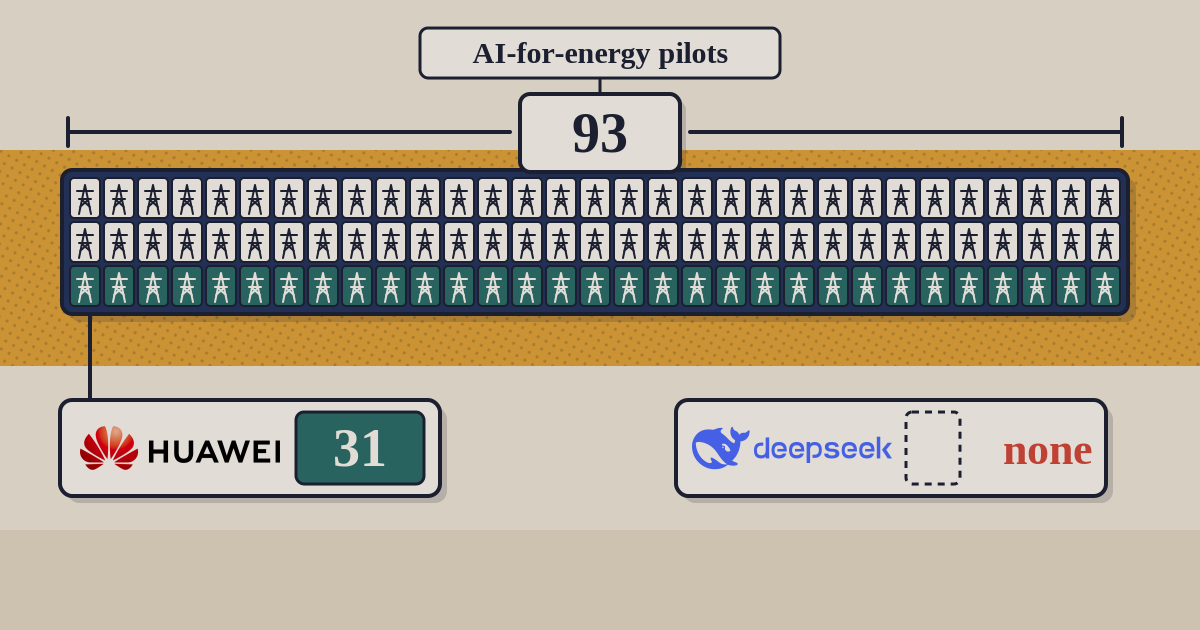
Huawei is a named technology provider on 31 of the 93 “AI + energy” pilot projects that China’s National Energy Administration (NEA) designated in Announcement No. 6 of 2026, signed on 24 November and posted on 27 November. DeepSeek is named on none.12 The NEA says the 93 were chosen “after expert review and public notice” to speed up the use of AI in the energy sector and promote “two-way empowerment and deep integration” of AI and energy.1
01Who supplies the technology
The attached list gives each project a field, a “high-value scenario”, a scenario provider (the energy company that offers the site and the problem) and technology providers. We counted the technology column: 489 entries from 267 organisations. After Huawei come Tsinghua University and North China Electric Power University on 14 projects each, then the China Electric Power Research Institute on 11. Of the large Chinese AI and cloud companies, Baidu is on 7, Alibaba Cloud on 6, iFlytek and Zhipu on 4 each and Tencent Cloud on 1; at least one of these six is on 42 projects. A university is among the providers on 76.2
Huawei is on a third of China’s 93 AI-for-energy pilots; DeepSeek is on none
Pilot projects naming each company as a technology provider, of 93, NEA list of 24 November 2026
Source: National Energy Administration, Announcement No. 6 of 2026, attachment (TechBag count) · as of 28 November 2026, 7:00pm IST · A project can name several providers
02What the pilots cover
The 93 projects fall under 48 scenarios in eight fields: new business forms such as storage, virtual power plants, vehicle-to-grid and green hydrogen (19 projects), the grid (18), new energy such as wind and solar (14), thermal power (11), nuclear (9, one of them on fusion plasma control), hydropower (8), oil and gas (8) and coal (6). Units of State Grid and China Southern Grid are scenario providers on 28, including all 18 grid projects. Two pilots tie AI to its own power supply: data centres fed directly by green electricity, one with data-centre operator GDS and Alibaba Cloud, one at the national computing hub in Zhongwei, Ningxia.2
The pilots follow an action plan of 8 April from four national bodies, led by the planning commission and the NEA, which asks for at least five specialised large models in deep use across the grid, power generation, coal, oil and gas, and for domestic AI chips to be adapted to domestic deep-learning frameworks. By 2030 it wants energy-sector AI, and clean power for AI computing, at “world-leading” levels.3 The NEA released the first 51 high-value scenarios on 26 May, when 25 energy companies signed a pledge to open them up.4
What happens next: project owners are to report progress and “major matters” regularly to the body that recommended them, the provincial energy authority or the state-owned group’s headquarters, which report on to the NEA; reporting rules will follow separately. The announcement sets no budget and no deadline beyond completing the pilots “on schedule”.1
Sources
- National Energy Administration, 国家能源局公告 2026年第6号 (Announcement No. 6 of 2026, in Chinese), signed 24 November 2026 — 27 November 2026
- National Energy Administration, attachment: “人工智能+”能源试点项目清单 (list of 93 “AI+” energy pilot projects, Word file, in Chinese) — 27 November 2026
- NDRC, NEA, MIIT and National Data Administration, 关于促进人工智能与能源双向赋能的行动方案 (action plan on two-way empowerment of AI and energy, 国能发科技〔2026〕34号, in Chinese) — 8 April 2026
- Xinhua (from Economic Information Daily), AI与能源“双向奔赴” 首批51个高价值场景发布 (first 51 high-value scenarios released, in Chinese) — 27 May 2026
Disclosure. TechBag is a software reseller: it earns when companies buy through it, including from vendors named here. The analysis is TechBag’s own; no vendor paid for or saw this piece before publication. Facts are labelled reported, TechBag count or our view. How the Journal works.
Keep reading