China’s chip index rose a record 17.6% the day the State Council pledged support
Index data for Friday 27 November: what the State Council’s readout said about Central Huijin and the “national team”, when it came out, and how far China’s chip stocks rose.

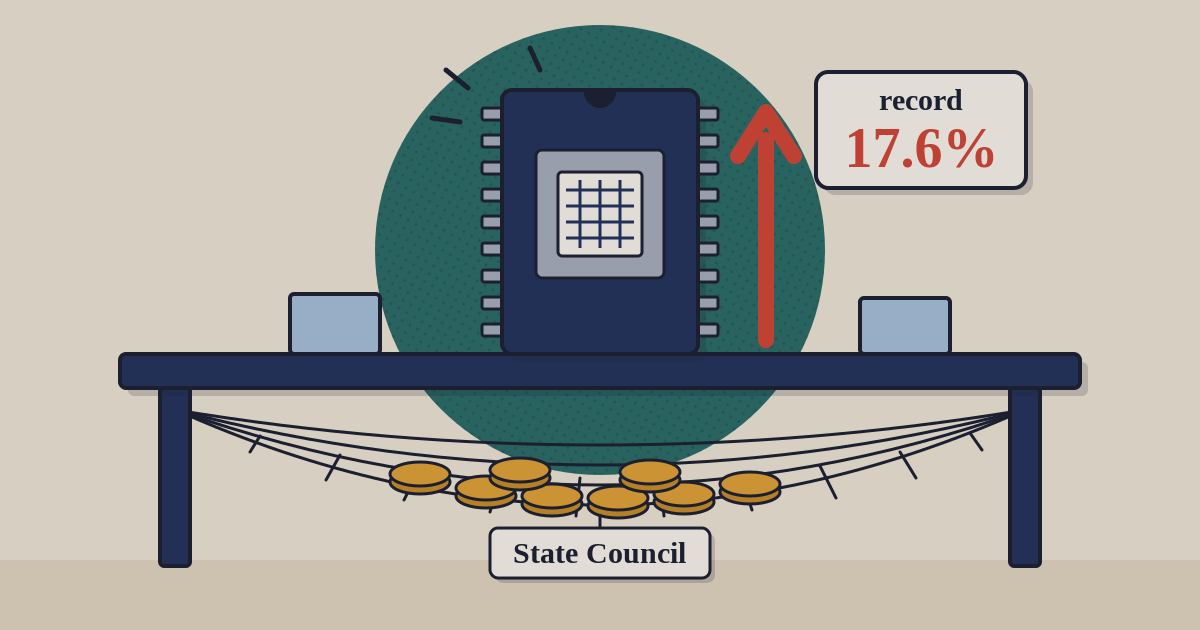
China’s CSI Semiconductor Industry index, which tracks up to 40 companies in semiconductor materials, equipment and applications, rose 17.59% on Friday 27 November to 6,685.06, the largest one-day rise since its base date in December 2016. The previous largest was 16.97%, on 8 October 2024.3 The CSI 300 of large Shanghai and Shenzhen shares rose 4.17% to 4,063.06, its biggest daily gain since that same day; on Wednesday it had closed at 3,898.24, its lowest since June 2025.3 The Shanghai Composite rose 3.73% to 3,606.49, on turnover of RMB929.8bn in its shares, 51.6% more than on Thursday.4 The same day the State Council, China’s cabinet, published what it wants done about the stock market.
China’s chip index had its biggest day on record; Hong Kong’s Hang Seng rose 2.1%
Change in closing level, Friday 27 November 2026 against Thursday 26 November, %
Source: China Securities Index; Shanghai Stock Exchange; HKEX Daily Quotations · as of 27 November 2026, 7:30pm IST · STAR 50 is the Shanghai STAR Market's 50 largest companies
01What the State Council said, and when
Premier Li Qiang chaired the State Council’s executive meeting on Friday morning. Its readout, from the state news agency Xinhua, was posted on the government’s Chinese site at 12:25pm Beijing time, while the mainland exchanges were shut for lunch between 11:30am and 1pm.2 It called the capital market “vital to overall economic development” and listed what should happen next:1
Encourage listed companies to pay more dividends and step up share repurchases, give greater play to state-backed funds in steadying the market, and optimize the quasi-“stabilization fund” function of the state-owned Central Huijin Investment Ltd. to provide sufficient liquidity.
The Chinese text is plainer: it asks to “step up the market-stabilising role of the ‘national team’”, in quotation marks. It also asks for more insurance, annuity and social-security money in shares, for defence against “imported risks”, for action against financial fraud and rule-breaking share sales, and to “plan and introduce incremental policies”.12 The Shanghai Composite stood 0.28% up at the midday break and 3.73% up at the close, so 92% of its gain came in the afternoon; the STAR 50 was up 4.43% at midday and 15.07% at the close.4 Hong Kong’s Hang Seng Index was 0.85% up at its midday close and ended 2.11% higher, at 22,694.77.5 We report the timing; neither the exchanges nor the State Council link the two.
02What Central Huijin is, and what is new
Central Huijin Investment is a wholly state-owned company that controls or holds stakes in more than twenty financial institutions. In its own words, published by Xinhua on 8 April 2025, it is the capital market’s “national team” and plays a quasi-“stabilization fund” role, and it has taken part in stabilising the market several times since 2008. It said then that its money comes from yearly cash dividends, its own funds, market borrowing and liquidity support from the People’s Bank of China.6 On 7 April 2025 it had announced that it was again buying exchange-traded funds and would keep buying; the central bank said it would lend Huijin “sufficient” money “when necessary”.67
So the role is not new. What is new, by Xinhua’s own account, is where it was said: the phrase “national team” appeared in a State Council executive meeting readout for the first time.8 In April 2025 the pledges came from Huijin and the central bank; on Friday they came from the cabinet, chaired by the premier.
03What one day does not undo
The chip index closed 41.2% below its high of 11,377.82 on 9 July and would need to rise 70.2% to regain it. It is 35.1% above its 2025 close. Big single days are not rare in it this year: it rose 14.71% on 21 July and 14.23% on 4 November.3 The CSI 300 is 19.7% below its 22 June high and 12.2% below its 2025 close.3 In Taipei, Seoul and Tokyo, our Trend on Asia’s week follows the same week from the other side. What to watch: what the incremental policies turn out to be, and Huijin’s holdings as funds publish their reports.
Sources
- The State Council of the PRC (Xinhua), Chinese premier chairs State Council executive meeting — 27 November 2026, 1:08pm Beijing
- 中国政府网 (Xinhua), 李强主持召开国务院常务会议 (Li Qiang chairs State Council executive meeting; Chinese, translation ours) — 27 November 2026, 12:25pm Beijing
- China Securities Index, index performance data: CSI Semiconductor Industry (931865), CSI 300 (000300), STAR 50 (000688) — 27 November 2026
- Shanghai Stock Exchange, SSE Composite Index daily and one-minute market data — 27 November 2026
- Hong Kong Exchanges and Clearing, Daily Quotations, 27 November 2026 — 27 November 2026
- Xinhua, 中央汇金发挥类“平准基金”作用 坚决维护资本市场平稳运行 (Central Huijin answers questions on its 7 April announcement; Chinese, translation ours) — 8 April 2025
- Xinhua, 中国人民银行:必要时向中央汇金公司提供充足的再贷款支持 (PBoC spokesperson on support for Central Huijin; Chinese, translation ours) — 8 April 2025
- 中国政府网 (Xinhua), 国常会关于资本市场部署释放五大鲜明信号 (five signals from the meeting on the capital market; Chinese, translation ours) — 27 November 2026, 3:35pm Beijing
- CNBC, Chinese chip stocks notch biggest ever one-day gains as Beijing signals broader market support — 27 November 2026
Disclosure. TechBag is a software reseller: it earns when companies buy through it, including from vendors named here. The analysis is TechBag’s own; no vendor paid for or saw this piece before publication. Facts are labelled reported, TechBag count or our view. How the Journal works.
Keep reading