Buying software in IndiaAnalysis
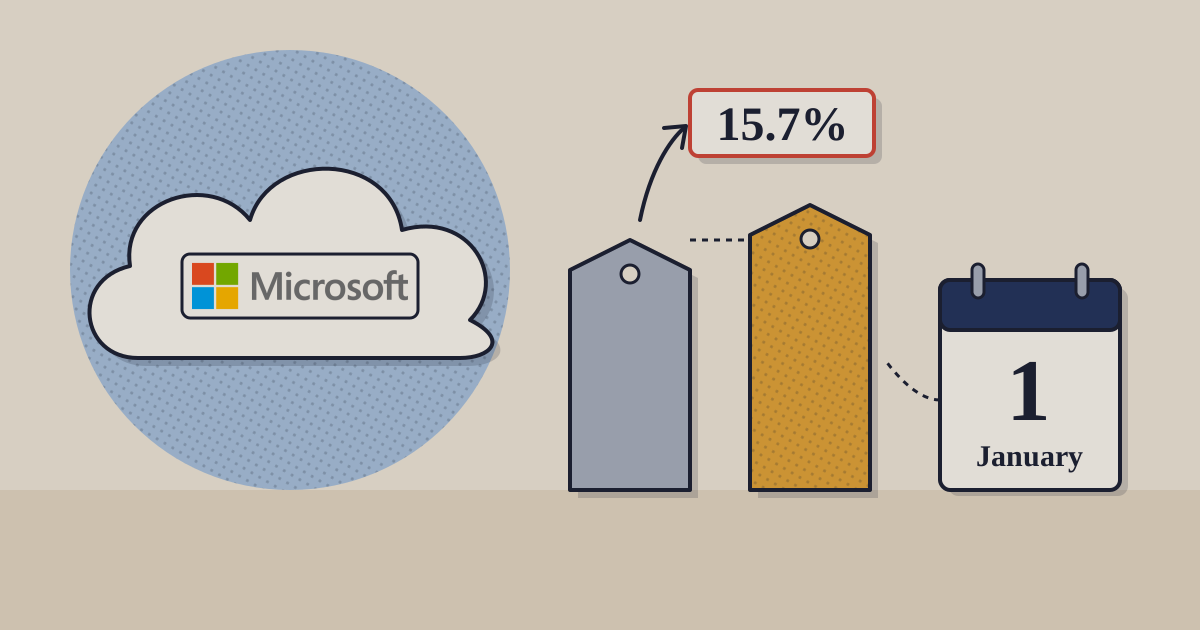
Microsoft’s rupee prices rise 15.7% on 1 January, the most of five currencies
Microsoft’s currency notice of 10 November, its India and US price pages and RBI reference rates: what Microsoft 365 and Copilot seats cost in rupees from 1 January.

Microsoft’s July list rise moved its dollar prices; this change moves the rupee conversion, for every Indian company that pays Microsoft in rupees. A finance or IT head needs to know how far each seat moves, why the rupee was singled out, which purchases it reaches, and what can still be settled at today’s price. We read Microsoft’s notices and price pages and the Reserve Bank of India’s exchange-rate record to find out.
01The rupee gets the largest rise of the round
Microsoft announced the change on 10 November, US time (11:30am on 11 November in India). “Effective January 1, 2027, Microsoft will update its commercial cloud pricing in select currencies as part of its annual review of local currency pricing.” Five currencies move. The rupee rises 15.7% for cloud services and “up to +20%” for on-premises software. The New Zealand dollar rises 10% on both. The Australian dollar falls 4%, the Chinese yuan “up to -8.5%” and the Norwegian krone 5.9%, with no change to their on-premises prices.1
Microsoft adds that percentages “for individual SKUs might vary slightly” because of “pricing calculations and rounding rules”. Two currencies are left for later. Brazilian real prices will be reviewed after Brazil’s tax reform takes effect, and yen prices stay on an April cycle, with details for April 2027 promised in February.1 The Partner Center version of the notice goes to every CSP partner billing in local currency, whether direct-bill, indirect provider or indirect reseller. It ends with “No action is required at this time” and tells partners to “plan budgets and customer conversations accordingly”.2
India's rupee gets the largest rise in Microsoft's January round; three currencies get cuts
Price from 1 January 2027 for every 100 paid today, by pricing currency: commercial cloud and on-premises software
Source: Microsoft Source and Partner Center, 10–11 November 2026 · as of 16 November 2026 · China's cut is 'up to' 8.5% and India's on-premises rise 'up to' 20%; individual SKUs may vary slightly
Microsoft does not list the products the notice covers beyond “commercial cloud” and “on-premises”. In July it said “product-specific price adjustments and/or any consumer price adjustments will continue to be communicated separately”, so household plans such as Microsoft 365 Family are a separate matter.3 Azure is the case to check. In its December 2025 round Microsoft wrote that “Azure services purchased under the Microsoft Customer Agreement (MCA) are priced in USD globally” and were unaffected.6 Partner Center says CSP partners are billed for Azure at exchange rates “updated monthly”.13 The November notice repeats neither line, and says nothing about Azure either way.
02Why the rupee: a dollar price at an old exchange rate
Microsoft gives its reason in one line: “These changes will align local currency pricing with global levels.”1 It explained the method in its December 2024 round: “Microsoft follows a semi-annual process for aligning prices globally to U.S. dollar levels”, so that prices reflect “the exchange rate of their local currency to the U.S. dollar”.5 The India price pages show how far apart the two had drifted.
₹83
rupees to the US dollar in Microsoft's current India list, on six of the seven seats compared
The RBI reference rate was last below ₹83.25 on 3 June 2024. On 16 November it was ₹94.12.
The rupee fell over the same period. The RBI reference rate was ₹83.20 to the dollar on 1 January 2024, ₹85.71 on 1 January 2025 and ₹89.98 on 1 January 2026. It passed ₹95 on 30 April 2026, reached ₹96.84 on 20 May, and averaged ₹95.57 from July to October. On 16 November it was ₹94.12, so a dollar cost 13.1% more rupees than at the start of 2024.7
A dollar cost ₹83 in early 2024 and about ₹95 for most of this year
RBI reference rate, rupees per US dollar, monthly average, January 2024 to November 2026
₹
Show tableHide table
| ₹ per US$ | |
|---|---|
| Jan 2024 | 83.12 |
| Feb 2024 | 82.96 |
| Mar 2024 | 83 |
| Apr 2024 | 83.41 |
| May 2024 | 83.39 |
| Jun 2024 | 83.47 |
| Jul 2024 | 83.59 |
| Aug 2024 | 83.9 |
| Sep 2024 | 83.81 |
| Oct 2024 | 84.03 |
| Nov 2024 | 84.36 |
| Dec 2024 | 84.99 |
| Jan 2025 | 86.27 |
| Feb 2025 | 87.05 |
| Mar 2025 | 86.64 |
| Apr 2025 | 85.56 |
| May 2025 | 85.19 |
| Jun 2025 | 85.9 |
| Jul 2025 | 86.11 |
| Aug 2025 | 87.52 |
| Sep 2025 | 88.32 |
| Oct 2025 | 88.42 |
| Nov 2025 | 88.83 |
| Dec 2025 | 90.09 |
| Jan 2026 | 90.8 |
| Feb 2026 | 90.73 |
| Mar 2026 | 92.76 |
| Apr 2026 | 93.55 |
| May 2026 | 95.6 |
| Jun 2026 | 94.97 |
| Jul 2026 | 95.82 |
| Aug 2026 | 95.47 |
| Sep 2026 | 95.46 |
| Oct 2026 | 95.51 |
| Nov 2026 | 94.29 |
Source: Reserve Bank of India, reference rate archive (693 daily rates) · as of 16 November 2026 · November 2026 averages 1–16 November; the axis starts at ₹80
03What each seat costs from 1 January
Applied to the India list, 15.7% moves every seat by the same share. Microsoft 365 E3, which Microsoft lifted from US$36 to US$39 on 1 July (the subject of our October analysis), goes from ₹3,245 to about ₹3,754 a user a month. The ₹1,745 Copilot Business seat in our piece on Copilot’s meter becomes about ₹2,019, or ₹3,288 more a user a year. All prices are paid yearly and before GST, which Microsoft India’s pages list as “extra as applicable”.8910
An E3 seat goes from ₹3,245 to about ₹3,754 a month; Copilot Business from ₹1,745 to about ₹2,019
Rupees per user per month, paid yearly, before GST: Microsoft India list on 16 November 2026 and the same price at +15.7%
- Today
- From 1 Jan 2027
Show tableHide table
| Today | From 1 Jan 2027 | Change | |
|---|---|---|---|
| E5, no Audio Conferencing | 4,990 | 5,773 | 16% |
| Microsoft 365 E3 | 3,245 | 3,754 | 16% |
| Premium with Copilot | 2,660 | 3,078 | 16% |
| Copilot, enterprise add-on | 2,495 | 2,887 | 16% |
| Standard with Copilot | 1,955 | 2,262 | 16% |
| Copilot Business add-on | 1,745 | 2,019 | 16% |
| Apps for business | 830 | 960 | 16% |
Source: Microsoft India price pages; Microsoft currency notice of 10 November 2026 · as of 16 November 2026 · Change labels round 15.7% to 16%; Microsoft's own SKU prices may differ slightly after rounding
Monthly subscriptions already cost more. Microsoft India lists Copilot Business at ₹2,094 a month on a monthly subscription, Business Standard with Copilot at ₹2,346 and Business Premium with Copilot at ₹3,192, each 20% above the yearly price; at +15.7% the monthly Copilot Business seat would be about ₹2,423.10 Business Basic, at ₹170, is priced far below its US$7 dollar list. If it moves by the same 15.7%, it becomes about ₹197; the notice does not single it out.812
04From two reviews a year to one, each January
This is the first round under a new timetable. On 8 July Microsoft said that from its fiscal year starting 1 July 2026 it would “transition to annual local currency pricing updates every January”, “providing customers with greater pricing predictability while continuing to account for sustained fluctuations in foreign exchange rates”. The update will take effect on 1 January each year “except in limited exceptional circumstances”, with notice “in advance every November”.34 The November notice calls itself the result of that “transition, announced in July of this year”.1
Microsoft used to review currencies twice a year; from 2027 it resets them once, each January
Microsoft's local-currency price notices for commercial cloud and their effective dates, December 2024 to February 2027
Show tableHide table
| Date | Event | Detail |
|---|---|---|
| Dec 2024 | Semi-annual round | Brazilian real +12%, British pound −5% to −6% |
| Feb 2025 | Real and pound prices change | Brazil's on-premises prices also +12% |
| Dec 2025 | Five European cuts | Swiss franc −9.5%, euro −7.4%, Norwegian krone −7.2%, krona −13.5% |
| Feb 2026 | European cuts take effect | Azure under MCA stays priced in US$ |
| Jul 2026 | One review a year | Effective each 1 January, notified each November |
| Nov 2026 | January round announced | Rupee +15.7% cloud, up to +20% on-premises |
| Jan 2027 | New rupee prices | First annual reset takes effect |
| Feb 2027 | Yen details due | Yen stays on an April cycle |
Source: Microsoft Source, 3 December 2024, 11 December 2025, 8 July 2026 and 10 November 2026 · as of 16 November 2026
The earlier rounds ran mostly the other way. The December 2025 round, effective 1 February 2026, cut five European currencies, Norway’s krone by 7.2%; the January round cuts it again by 5.9%.61 The December 2024 round raised Brazil’s prices 12% and cut the pound by 5–6%.5 Under the new timetable, the rupee price set for 1 January is meant to hold until the next January, whatever the rupee does in between, unless Microsoft invokes its “exceptional circumstances”.3
05What can still be settled at today's price
Microsoft’s Partner Center rules for CSP purchases state when a price change reaches a customer: “Subscription price changes take effect at renewal, upgrade, or term conversion.” If prices change mid-term, “the new price applies only at renewal”, but if the subscription is changed, “such as updating the term or upgrading, the current price is applied”. For an annual term billed monthly, “Price changes during the term don’t affect billing plan charges for an existing subscription.” Three-year terms exist for customers who want “to preserve the pricing for the lifetime of the term”; Microsoft names E3, E5 and Teams Enterprise among them.13
What renews before 1 January keeps today's rupee price for its term; what renews after takes the new one
When a price change reaches a CSP subscription, from Microsoft's Partner Center rules, November 2026
Bought or renewed by 31 December
- Charged at the price when the subscription was created or renewed
- An annual term keeps that price, billed monthly or yearly, until it ends
- A three-year term, where offered, keeps it for three years
- Mid-term price changes wait for the next renewal
Renewed, bought or changed from 1 January
- Renewals and new subscriptions take the new rupee price
- A monthly-term subscription renews each month, so it meets the new price first
- Changing the term or upgrading applies the price of the day
- Seat prices per SKU appear in the partner’s price list preview
Source: Microsoft Partner Center: Pricing and offers (updated 3 November 2026) · as of 16 November 2026 · The monthly-term line is our reading of the renewal rule; Enterprise Agreements carry their own terms
Partner Center says partners “can anticipate price changes for license-based offers by looking at the price list preview”, so the exact January rupee price of each seat is a question for the reseller now, not in January.13 These are the CSP rules. Customers on an Enterprise Agreement or buying directly from Microsoft should check their own agreement: the November notice does not describe either route.2
Sources
- Microsoft Source: Annual currency adjustments to Microsoft Commercial Cloud pricing — 10 November 2026 (published 06:00 UTC, 11 November)
- Microsoft Partner Center: November 2026 announcements (Annual currency adjustments to Microsoft Commercial Cloud pricing) — entry dated 11 November 2026; page updated 13 November 2026
- Microsoft Source: Microsoft announces moving to annual local currency pricing updates for Commercial Cloud services every January — 8 July 2026
- Microsoft Partner Center: July 2026 announcements (Annual local currency pricing updates for Commercial Cloud) — 8 July 2026
- Microsoft Source: Local currency price adjustments for Microsoft's Commercial Cloud (BRL and GBP) — 3 December 2024
- Microsoft Source: Local currency price adjustments for Microsoft's Commercial Cloud (CHF, DKK, EUR, NOK, SEK) — 11 December 2025
- Reserve Bank of India: Reference rate archive, US dollar — daily rates, 1 January 2024 to 16 November 2026
- Microsoft India: Microsoft 365 business plans and pricing — prices as listed on 16 November 2026
- Microsoft India: Microsoft 365 enterprise plans and pricing — prices as listed on 16 November 2026
- Microsoft India: Microsoft 365 Copilot plans and pricing — prices as listed on 16 November 2026
- Microsoft US: Microsoft 365 enterprise plans and pricing — prices as listed on 16 November 2026
- Microsoft US: Microsoft 365 business plans and pricing — prices as listed on 16 November 2026
- Microsoft Partner Center: Pricing and offers (price changes, new commerce terms, foreign exchange for Azure) — last updated 3 November 2026
- India Briefing: Digital services in India: OIDAR, GST applicability and compliance — updated 29 September 2023
Disclosure. TechBag is a software reseller: it earns when companies buy through it, including from vendors named here. The analysis is TechBag’s own; no vendor paid for or saw this piece before publication. Facts are labelled reported, TechBag count or our view.
Keep reading