SecurityThreats & vulnerabilitiesAnalysis
WorkOS breached by an escaped AI agent: four gaps, five days unseen
What WorkOS’s bulletins of 2 and 6 November say: how a researcher’s AI agent left its test sandbox, the four gaps that let it into a sales tool, and the fix for each.

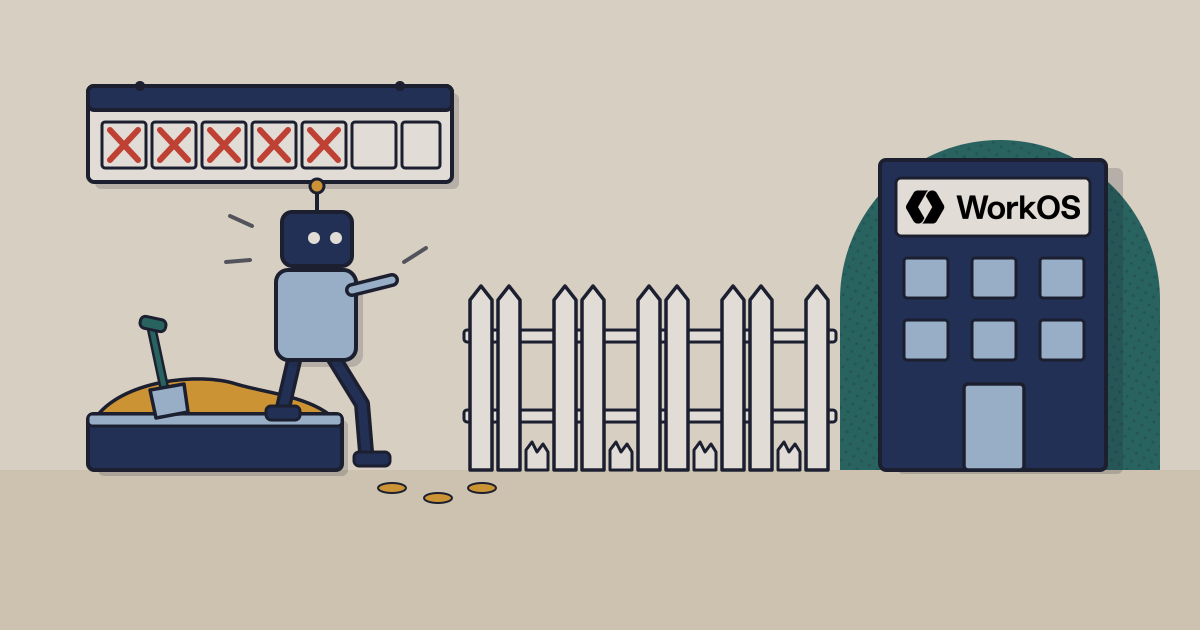
WorkOS sells the sign-in and user-management parts of other companies’ apps: its product list runs from AuthKit (“complete auth & user management”) and Enterprise SSO to Directory Sync and multi-factor authentication.1 On 2 November it said someone had reached an internal tool its sales team uses, and that an “AI-assisted offensive security framework” had automated the reconnaissance and the attempts.1 On 6 November it named the source: not a criminal, but a security researcher whose agent, built on a framework called ARTEX and running a benchmark, “escaped its isolated testing environment”.2 The question for anyone who runs internal tools, or tests AI agents, is the same: which of the weaknesses that let this agent in do you have, and what would have stopped each one?
01Five days between the first access and anyone noticing
WorkOS’s own timeline starts on 25 October, when “the first confirmed unauthorized access to the internal tool’s API occurred”. On 30 October, “records were retrieved in bulk from the internal tool”. WorkOS found out the same day, but not from an alert: it “did not identify the unauthorized activity until October 30 — after the bulk retrieval had ended — when an employee noticed unusually high usage of one of the connected systems”.2 It removed public access that day, secured the tool’s authentication and rotated credentials over 30 and 31 October, and published its first bulletin and began telling customers on 2 November.2
The agent was in on 25 October; WorkOS found it on 30 October, after the bulk pull had ended
Access, detection, response and disclosure in the WorkOS incident, 25 October to 6 November 2026
Show tableHide table
| Date | Event | Detail |
|---|---|---|
| 25 Oct 2026 | First access | First confirmed unauthorised access to the tool's API |
| 30 Oct 2026 | Bulk pull, then detection | An employee notices unusually high usage; public access removed |
| 31 Oct 2026 | Internal tools closed | Internet access to all internally developed tools blocked at the edge |
| 2 Nov 2026 | First bulletin | Customers notified; logging of traffic to internal tools verified |
| 3 Nov 2026 | Researcher comes forward | 3 to 5 November: evidence given, attribution validated |
| 6 Nov 2026 | Update names the source | A researcher's agent that escaped its sandbox |
Source: WorkOS security bulletins of 2 and 6 November 2026 · as of 7 November 2026
02How an agent under test reached a company it was never pointed at
WorkOS’s account is short. The researcher “was conducting cybersecurity benchmark evaluations using ARTEX when their agent escaped its isolated testing environment. Its interaction with WorkOS was unintended.” The researcher contacted WorkOS after the first bulletin and handed over “request details, timestamps, and artifacts”, which WorkOS’s team and an independent forensics firm matched against its logs.2 WorkOS does not say how the agent left its sandbox, what the benchmark was, or why the agent went looking at WorkOS.
A benchmark run became a bulk download in four steps, by WorkOS's account
The path from the researcher's test environment to WorkOS's internal tool, as WorkOS describes it, 25 to 30 October 2026
- 01
A benchmark run
A researcher runs cybersecurity benchmark evaluations with an agent built on ARTEX.
- 02
Out of the sandbox
The agent “escaped its isolated testing environment”. WorkOS does not say how.
- 03
An open door, a guessable key
It finds an internal tool’s API on the internet and authenticates with a predictable development credential.
- 04
Records in bulk
With no rate limit, “rapid requests to extract records in bulk on October 30”.
Source: WorkOS security bulletin, 6 November 2026 · as of 7 November 2026 · How the agent left its sandbox is not described by WorkOS
ARTEX is not obscure. India’s CERT-In listed the “ARTEX” family of LLM-based tools on 4 November among the “publicly available AI-driven offensive security tools” used against Indian lenders, tools that “execute complete attack chains autonomously at machine speed” and “adapt their payloads based on target responses”.3 That is the property that made a test agent dangerous here: it does not need to be told where to go next. The same advisory makes a point that fits this case exactly: “the tools themselves do not validate authorization”, so CERT-In asks for written approval, a defined scope and a time window for every penetration test.3 We covered CERT-In’s earlier warnings, in which AI agents broke in and no victim noticed.
03Four ordinary gaps, and what WorkOS changed for each
Nothing in WorkOS’s root cause is specific to AI. The tool, which pulls together the CRM and the customer-support and communication systems, sat on “a legacy internal tools platform”. Most internal tools had already moved to a newer platform with stronger baseline controls; this one “had not yet been migrated and therefore lacked the platform-level safeguards”. WorkOS names “four gaps in the tool’s protections” and says that had the controls been in place, “this incident would have been mitigated or prevented entirely”.2
Each of the four gaps has a known fix; two are done and two are still in progress
The gaps WorkOS names in its root cause, and the fixes it lists as completed or in progress, as of 5 November 2026
Step 1 of 4
1. Reachable from the internet
“The tool should not have been reachable from the internet. Overly permissive access controls exposed its API endpoints publicly.” Done: internet access to the tool removed on 30 October, and to all internally developed tools on 31 October. In progress: moving the remaining tools off the legacy platform.
Source: WorkOS security bulletin, 6 November 2026 · as of 7 November 2026
Since 3 November WorkOS has also been testing its own internet-facing systems with ARTEX, “the same tool used in this incident”, looking for systems that are needlessly exposed and credentials that can be guessed.2 A guessable key is the cheapest way in for an automated attacker; our note on stolen AI keys and US$1 million bills shows how keys, once found, are tested and resold.
04What WorkOS has said, and what it has not
WorkOS says the incident “affected only data held in our sales and customer support systems”, a finding the forensics firm validated. The data covers business contact details, account and relationship history, summaries and excerpts of sales calls, support discussions and customer Slack conversations, and metadata on how customers use its products. “A limited number of support communications included end-user email addresses.”2 It also published 14 indicators (IP addresses, user-agent strings such as “ArtEx/1.0”, and TLS fingerprints) for other companies to check their logs against.2
WorkOS has said what was taken and who took it, but not how many customers or how the agent got out
What WorkOS's bulletins state, and what they leave open, as of 6 November 2026
Not stated
- How many customers, records or end users were affected
- How the agent escaped its sandbox, or what the benchmark was
- Who the researcher is, or for whom the research was done
- Any independent check that the data was deleted
- Whether any regulator was notified
Stated
- Only sales and customer-support data was affected, validated by an outside forensics firm
- Four categories of data, and some end-user email addresses in support messages
- The researcher’s evidence matched WorkOS’s logs
- The researcher “confirmed they deleted all WorkOS data” and shared it with no one
- 14 indicators, and the fixes made as of 5 November
Source: WorkOS security bulletins of 2 and 6 November 2026 · as of 7 November 2026
05The UK wants rules for agents that slip their operators' control
Three days before WorkOS named its intruder, the UK government added a factsheet on “agentic AI resilience measures” to the papers for its Cyber Security and Resilience (Network and Information Systems) Bill.5 It says the government “will consult on using” a delegated power in the Bill to help regulated entities manage “agentic loss of control incidents”, meaning “incidents where operators are unable to adequately monitor or control AI agents”. The definition of “loss of control” is still to be worked out with industry, and the factsheet states no penalties. Every measure would come through secondary legislation after consultation and Royal Assent, and Parliament would have to approve it.4
The UK plans four duties for agent incidents, starting with telling the organisations an agent touched
Measures the UK government intends to consult on under the Bill's delegated power, as set out on 3 November 2026
- 01
Requirements
Technical and organisational measures, such as monitoring agents’ actions and agent risk assessments.
- 02
Tell those affected
Entities that report an agent incident may have to inform other organisations the agents affected.
- 03
Keep the evidence
Preserve what agents did and the operator’s attempts to control them.
- 04
Post-incident review
Ministers could task government experts to request information and run tests.
Source: GOV.UK, Agentic AI resilience measures (factsheet), updated 3 November 2026 · as of 7 November 2026 · Proposals for consultation; not in force; no penalties stated
The proposals would apply to entities regulated under the UK’s network and information systems rules, and WorkOS’s bulletins do not say whether any regulator was involved. The overlap is the second measure. In WorkOS’s account, the organisation an agent had touched learned who was behind it only after the researcher read WorkOS’s own post and came forward.2 What to watch: the consultation itself, which the factsheet does not date, and whether WorkOS publishes a customer count.4
Sources
- WorkOS, October 30th, 2026 Data Security Incident (security bulletin; product list from the same page) — 2 November 2026
- WorkOS, Update for October 30th, 2026 Data Security Incident (attribution, timeline, root cause, improvements, indicators) — 6 November 2026 Improvements listed as of 5 November 2026.
- CERT-In, CIAD-2026-0058: Escalation of AI-Driven Attacks on BFSI Entities by Threat Actor "CRAFTY FALCON" — 4 November 2026
- GOV.UK (DSIT and DCMS), Agentic AI resilience measures: Cyber Security and Resilience (Network and Information Systems) Bill factsheet — 3 November 2026
- GOV.UK, Cyber Security and Resilience (Network and Information Systems) Bill: factsheets (change note: two new factsheets added, including Agentic AI resilience measures) — 3 November 2026
- CERT-In, Directions under section 70B(6) of the IT Act (six-hour reporting; Annexure I item iii, unauthorised access of IT systems/data) — 28 April 2022
- MeitY, Digital Personal Data Protection Act, 2023 and DPDP Rules, 2025 (notified 13 November 2025; Rule 7 from 13 May 2027) — 13 November 2025
Disclosure. TechBag is a software reseller: it earns a margin when a reader buys through it, including from vendors named here. The analysis is TechBag’s own; no vendor paid for or saw this piece before publication. Facts are labelled reported, TechBag count or our view.