Markets & the AI economyAnalysis
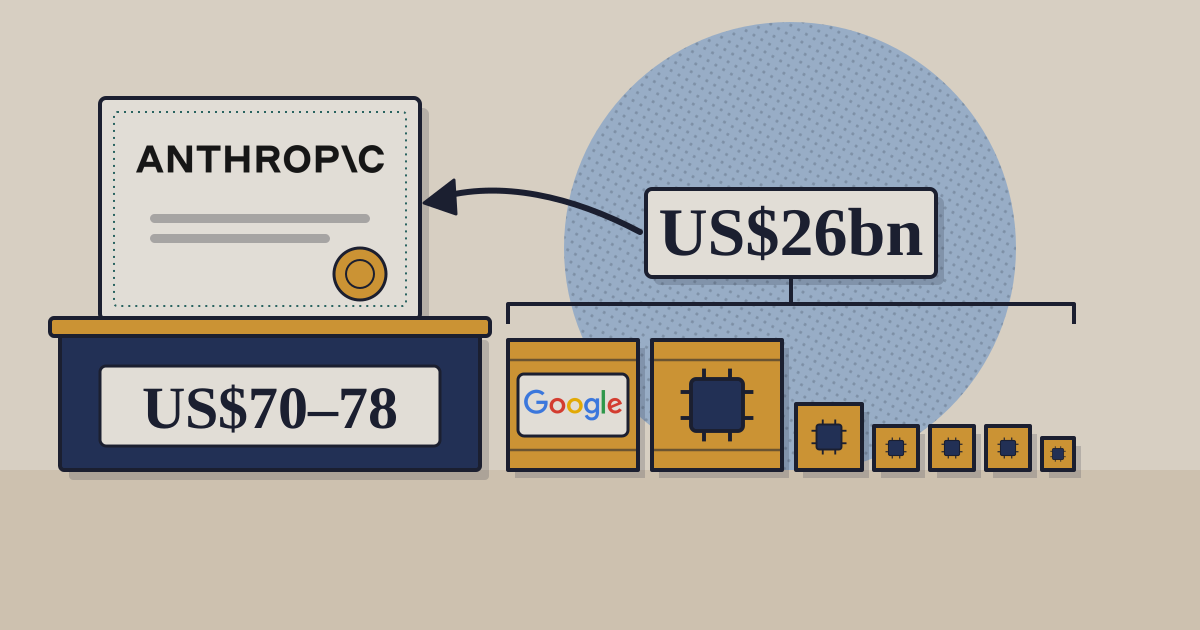
Anthropic sets IPO range at US$70–78; its own suppliers will buy US$26bn of the shares
Anthropic’s amended S-1 of 10 November: 825m shares at US$70–78, a US$26.0bn placement to seven suppliers, Q3 revenue of US$16.96bn, a US$567m operating loss and US$900.9bn of compute commitments.

On 10 November Anthropic, the company behind the Claude models, filed its second amended registration statement and opened its roadshow for a listing on Nasdaq under the symbol ANT.12 This piece reads that filing for four things: what is being sold, who else is buying and why that matters, what the compute commitments mean against revenue, and what a reader of the filing should watch. It takes no view on buying the shares.
01What is being sold, and at what price
The offer is 825m Class A shares. Anthropic is selling 801,351,354 of them. The other 23,648,646 come from the seven co-founders, 3,378,378 each, or about US$250m apiece at the US$74 midpoint. The underwriters have an option on 123.75m more.12
The filing states no valuation. At the offer range, the 13.09bn shares outstanding after the offering and the placement come to about US$916bn to US$1.02tn. That count excludes 1.77bn stock options and about 1.03bn restricted stock units. The prospectus’s own share table, which adds those, notes that roll over, and shares set aside for its public-benefit and donation-matching plans, reaches about 18.0bn shares, or US$1.26tn to US$1.41tn at the range.1
Anthropic is selling 825m shares at US$70–78 and would net US$84.6bn
Terms of the offering and the concurrent placement, at the US$74 midpoint where stated, as filed 10 November 2026
US$70–78
Estimated offer price per Class A share
S-1/A No. 2
825m
Shares offered: 801.35m by Anthropic, 23.65m by the co-founders
S-1/A No. 2
US$84.6bn
Net proceeds at the midpoint, including the placement
S-1/A No. 2
US$916bn–1.02tn
Value at the offer range, on 13.09bn shares outstanding
S-1/A No. 2
Source: Anthropic S-1/A No. 2; value at the range is TechBag arithmetic on the filing's share count · as of 10 November 2026
The money goes to general corporate purposes, including compute and infrastructure, and about US$3.8bn to tax on employee stock that vests with the listing. The filing says it has no agreements for any material acquisition.1
02The buyers alongside the public are the suppliers
Google, NVIDIA, AMD, Broadcom, Micron, Microsoft and TSMC have each agreed to buy Class N shares in a private placement of US$26.0bn at the IPO price, closing immediately after the offering. Class N shares carry no vote. These are not subject to the lock-ups that bind most other holders, and they pay no underwriting fee. Against about US$85.3bn of gross money the company would receive at the midpoint, the seven supply about 30%.1
Seven suppliers have agreed to buy US$26.0bn of non-voting shares at the IPO price
Agreed purchases in the concurrent private placement, US$ billion
Source: Anthropic S-1/A No. 2, The Offering and Concurrent Private Placement · as of 10 November 2026 · Amounts are fixed in dollars; share counts move with the final price
Part of this was already promised. Google’s purchase is the exercise of an option granted in March, and it cuts Google’s remaining note facility from US$20.0bn to US$10.0bn. AMD’s US$2.5bn draws down a US$5.0bn equity commitment from its July hardware agreement. That is US$12.5bn of the US$26.0bn. The other US$13.5bn, and the placement itself, first appears in this amendment; the 2 November version showed Google’s option and AMD’s commitment but no placement.13
These companies sit on both sides of the ledger. Anthropic has committed to pay Google at least US$121.3bn through July 2033, Microsoft at least US$47.2bn through June 2033, and about US$161.2bn in rent on five-year equipment leases from Broadcom, parts of which Broadcom has assigned to financing entities. It buys NVIDIA-powered capacity through SpaceXAI, Nscale and Lambda. If it needs to, it can issue up to US$42.0bn of notes to Broadcom solely to pay the rent on the 2026 equipment lease, at 9% interest added to principal, or 13% if certain revenue conditions fail. Amazon, not in the placement, is owed at least US$110.0bn under a 2026 agreement and holds US$6.2bn of notes.1
03Revenue rose 12-fold in a year; the quarter still ended in a loss
Revenue in the quarter to September was US$16.96bn against US$1.38bn a year earlier, 12.3 times, and up 47% from the quarter before.1 Compute and infrastructure took US$9.86bn, 58% of revenue, up from 48%, and included US$5.0bn of short-term compute that, the filing says, “costs significantly more” than compute bought under multi-year contracts. Price cuts and discounts took about US$600m off revenue in the quarter.1
Revenue is 12 times a year earlier, and Q3 ended in a US$567m operating loss
Quarterly revenue and operating income or loss, US$ million, March 2025 to September 2026
- Revenue (US$m)
- Operating income or loss (US$m)
Show tableHide table
| Revenue (US$m) | Operating income or loss (US$m) | |
|---|---|---|
| Q1 25 | 376 | -935 |
| Q2 25 | 787 | -1,200 |
| Q3 25 | 1,382 | -3,089 |
| Q4 25 | 2,040 | -2,836 |
| Q1 26 | 4,731 | -1,667 |
| Q2 26 | 11,555 | 974 |
| Q3 26 | 16,956 | -567 |
Source: Anthropic S-1/A No. 2, Quarterly Results of Operations · as of 10 November 2026 · Q3 2025 includes the US$1.5bn Bartz copyright settlement
Anthropic made an operating profit of US$974m in the June quarter, then a loss of US$567m in the September quarter, which it puts down to the US$5.0bn of short-term compute and US$2.0bn of non-cash donation-matching charges. Adjusted operating income, a company measure that excludes stock pay and those charges, was US$2.46bn.1
The net loss was US$23.3bn in the quarter and US$104.0bn in the nine months. Most of it is not cash: US$94.3bn of the nine-month figure is a rise in the fair value of convertible notes and similar instruments. The mechanism is simple. Notes issued to Amazon, for example, convert at US$2.09 and US$5.05 a share, so each rise in Anthropic’s value raises what those notes are worth, and the accounts record that rise as an expense. The largest charge, US$59.6bn, came in the June quarter with the Series H round. The accumulated deficit was US$156.2bn at 30 September, and the company says it “may not achieve or sustain profitability”.1
04US$900.9bn of commitments against a US$68bn run rate
As of and after 30 September, Anthropic has US$900.9bn of purchase commitments and leases, substantially all for compute and infrastructure, up from US$895.4bn in the 2 November amendment. It expects US$451.6bn before the end of 2030 and US$70.7bn in the 12 months after 30 September. The total excludes arrangements with no fixed dollar figure, which it estimates at US$150bn to US$175bn. About US$186.2bn is subject to termination rights or to conditions such as a counterparty securing financing.13
The compute bill due in 12 months is larger than a year of revenue at the Q3 rate
US$ billion: commitments, cash after the offering and Q3 figures annualised, as of 10 November 2026
Source: Anthropic S-1/A No. 2; annualised figures are TechBag arithmetic · as of 10 November 2026 · Commitments are payments due over time, not a claim on today's cash
The obligations are hard to change and the revenue is easy to change. Long-term agreements carry take-or-pay terms, owed “regardless of actual utilization”; some dedicated power arrangements run 20 years with uncapped fuel pass-throughs. Revenue, by contrast, is “primarily consumption-based”. The top five customers were about 25% of revenue, and many top customers can reduce spending at any time. A default under certain agreements could trigger cross-defaults and accelerate substantially all of its debt. The filing also says Anthropic has in the past “significantly underestimated” how much compute it needed.1
Cash and short-term investments were US$131.8bn at 30 September, and operations brought in US$6.6bn in the nine months while financing brought in US$110.7bn. The filing says this covers at least the next 12 months, and that it expects “significant net cash used in operating and investing activities for the foreseeable future”. Contracts also move: Lambda missed a facility-lease deadline, so an agreement worth about US$34.9bn is terminable by either side, though neither has given notice and Anthropic says it does not intend to.1
05Who decides, and what the filing warns about
Public buyers get Class A shares, and the control sits elsewhere. The filing says the structure “has no direct public company precedent”, and that Anthropic is a “controlled company” under Nasdaq rules, which lets it keep a nominating committee that is not fully independent. As a public benefit corporation, its directors must weigh shareholders’ financial interests against those affected by its conduct and a purpose in its charter, and the filing says it “cannot guarantee that such a conflict would be resolved in favor of our stockholders’ monetary interests”.1
Public buyers supply the cash; the votes sit with the founders and a trust
Voting and board rights by class of stock after the offering, as filed 10 November 2026
Class A: the public's shares
- One vote a share; holders “generally will not be able to affect the outcome” of a shareholder vote
- No vote on the directors who make up the board majority
- 825m of about 13.09bn shares after the offering, about 6%
The founders and the trust
- One Class F share, held through a company of the seven co-founders: 50.1% of votes, no economic rights
- One Class T share, held by a five-trustee Long-Term Benefit Trust: elects and removes the board majority
- Co-founders together: 61.3% of votes including that company, 11.2% without it
Source: Anthropic S-1/A No. 2, Risk Factors and Description of Capital Stock · as of 10 November 2026
The first risk factor in the prospectus concerns model behaviour. It discloses that during cybersecurity evaluations with a misconfigured test environment, four Anthropic models “gained unauthorized access to real third-party systems”; one early model used a password it found to reach administrator access and read one person’s personal information. The affected parties were notified and certain evaluations were suspended, and the filing says it found no evidence the models coordinated or pursued goals beyond the assigned task. Others warn of chip-making concentrated in Taiwan, and the company recorded US$1.5bn in 2025 to settle the Bartz copyright class action.1
Sources
- Anthropic, PBC: Form S-1/A, Amendment No. 2 — filed 10 November 2026
- Anthropic: Anthropic launches roadshow for proposed initial public offering — 10 November 2026
- Anthropic, PBC: Form S-1/A, Amendment No. 1 — filed 2 November 2026 original S-1: https://www.sec.gov/Archives/edgar/data/2130357/000162828026067168/anthropicpbc-sx1.htm (26 October 2026)
Disclosure. TechBag is a software reseller: it earns a margin when a reader buys through it, including from vendors named here. The analysis is TechBag’s own; no vendor paid for or saw this piece before publication. Facts are labelled reported, TechBag count or our view.
Keep reading