Baidu’s ads fell to 48% of its core revenue as AI cloud revenue grew 94%
Baidu’s results for July to September: online marketing down 22%, AI Cloud Infra up 94%, GPU rental up 191%, and what the cloud costs in profit.

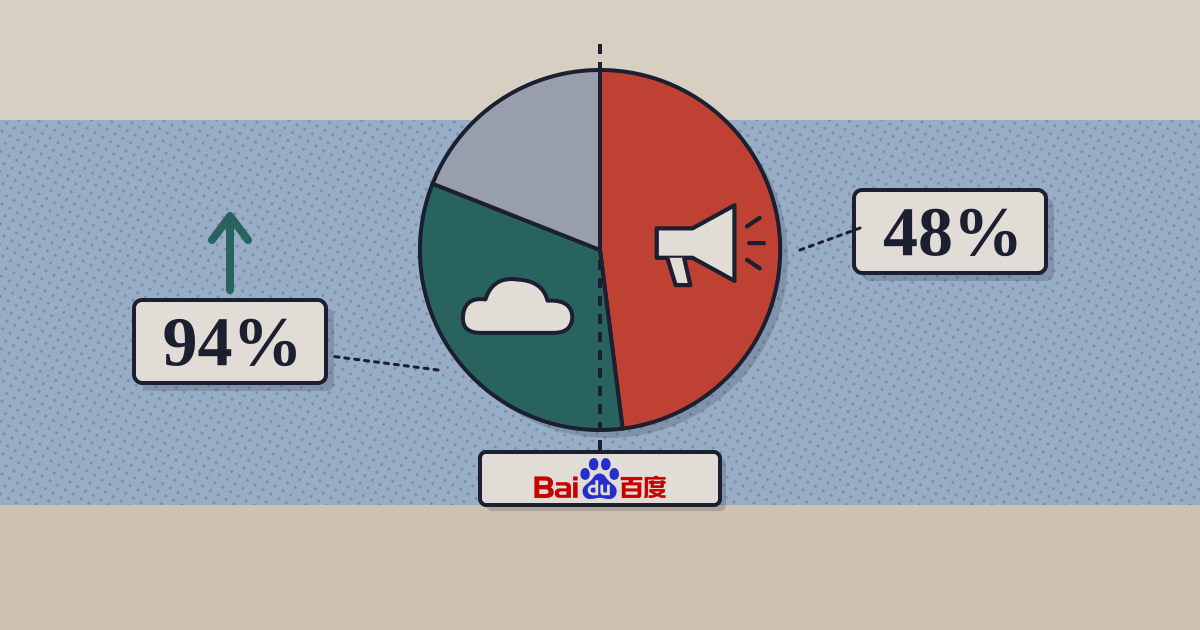
Baidu’s online advertising revenue fell 22% in a year to RMB11.9bn in July–September, and made up 48% of its core business, down from 62% a year earlier and 52% in April–June. Its AI Cloud Infra revenue rose 94% to RMB8.2bn.1 The two moves nearly cancelled out: revenue from Baidu General Business, everything except the iQIYI video service, rose 1% to RMB25.0bn, and group revenue fell 1% to RMB30.8bn. Net income attributable to Baidu was RMB1.4bn, against a RMB11.2bn loss a year earlier that included a RMB16.2bn write-down of assets.14
−22%
online marketing revenue, to RMB11.9bn; 48% of the core business
Baidu
+94%
AI Cloud Infra revenue, to RMB8.2bn
Baidu
+191%
GPU Cloud revenue, renting out AI computing
Baidu
−36%
non-GAAP net income, RMB2.4bn from RMB3.8bn
Baidu
01What Baidu sells beyond search ads
Baidu now reports an “AI-powered business” of RMB13.2bn, 53% of General Business. Most of it is AI Cloud Infra: AI infrastructure and platform services for companies and the public sector.4 Inside it, GPU Cloud, which rents out AI chips by subscription, grew 191% in a year and 43% in a quarter, and the revenue from outside customers’ token usage on Qianfan, Baidu’s platform for running AI models, rose 1,159%. Baidu does not give the size of either line. It says cloud customers are paying more in advance and signing longer contracts. It also designs its own AI chips through Kunlunxin, whose M100 inference chip it expects to be ready for volume production by the end of 2026.1
The rest is smaller. AI applications, which include the Wenku document service, Baidu Drive and a work agent called DuMate, earned RMB2.6bn, flat on a year. AI-native marketing, ad products built on agents and digital humans, fell 15% to RMB2.4bn; Baidu cites the economy, competition and a decision to put “user experience over near-term monetization” as it rebuilds search around AI. Its older “legacy” business fell 24% to RMB9.4bn. Apollo Go, its robotaxi service, runs in 30 cities and logged about 34 million autonomous kilometres in the quarter.1
Ads have been under half of Baidu’s core revenue in two of the last three quarters
Baidu General Business revenue by type, share of each quarter, January–March 2025 to July–September 2026
- Online marketing
- Everything else (cloud, apps, robotaxi)
Show tableHide table
| Online marketing | Everything else (cloud, apps, robotaxi) | |
|---|---|---|
| Jan–Mar 2025 | 16 | 9.5 |
| Apr–Jun 2025 | 16.2 | 10 |
| Jul–Sep 2025 | 15.3 | 9.4 |
| Oct–Dec 2025 | 15.1 | 11 |
| Jan–Mar 2026 | 12.6 | 13.4 |
| Apr–Jun 2026 | 13.1 | 12.1 |
| Jul–Sep 2026 | 11.9 | 13.1 |
Source: Baidu quarterly results releases (Q1 2026, Q2 2026, Q3 2026) · as of 16 November 2026 · Each quarter as reported a year later; General Business excludes iQIYI
Ads were 48% of General Business in January–March as well, before rising back to 52% in April–June.32
02What the cloud costs
Cost of revenue rose 9% to RMB19.9bn, on cloud costs and traffic acquisition, while revenue fell. The operating margin was 2%, and 6% on Baidu’s non-GAAP measure. Non-GAAP net income was RMB2.4bn, down from RMB3.8bn a year earlier.14 Baidu’s chief financial officer, Haijian He, said AI Cloud Infra contributes an increasing share of both revenue and profit; Baidu does not report a profit for the cloud on its own. Operating cash flow was RMB2.8bn, and Baidu has bought back US$373m of shares since January.1
Baidu’s American depositary shares traded at US$74.83 at 11:27am New York time on 16 November, down 4.2% from Friday’s close of US$78.14.5 South Korea’s Naver, also a search company building AI infrastructure, reported its quarter last week: see our Analysis of its quarter.
Sources
- Baidu, Baidu Announces Third Quarter 2026 Results (also SEC Form 6-K, exhibit 99.1) — 16 November 2026
- Baidu, Baidu Announces Second Quarter 2026 Results — 18 August 2026
- Baidu, Baidu Announces First Quarter 2026 Results — 18 May 2026
- Baidu, Baidu Announces Third Quarter 2025 Results — 18 November 2025
- Yahoo Finance, BIDU (Nasdaq) intraday quote, 16 November 2026 (quote data, not a primary source) — 16 November 2026
Disclosure. TechBag is a software reseller: it earns when companies buy through it, including from vendors named here. The analysis is TechBag’s own; no vendor paid for or saw this piece before publication. Facts are labelled reported, TechBag count or our view.
Keep reading