SecurityThreats & vulnerabilitiesNote
Check Point management servers: data taken from 24 at 22 organisations in 17 countries
GreyNoise’s report of 23 November and Check Point’s July advisory: how one actor used a login bypass on firewall management servers, 17 October to 2 November, and what to check.

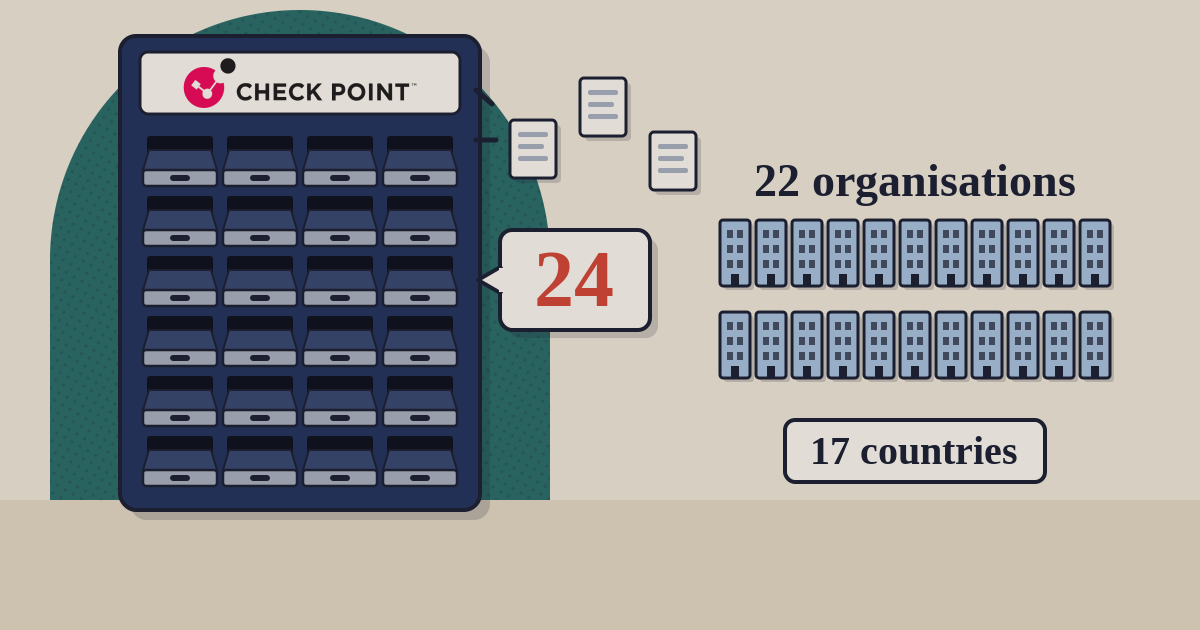
An actor working from 99 IP addresses took data from 24 Check Point Security Management Servers belonging to at least 22 organisations, GreyNoise reported on 23 November, with confirmed attack activity between 17 October and 2 November 2026. The victims have assets in 17 countries and sit in financial services, energy, government, transport, mining, engineering and manufacturing. GreyNoise tracks the activity as GreyNoise Threat 13 (GT13) and writes: “We do not attribute GT13 to any known or publicly tracked threat group at this time.” Its own view of the victims’ servers stopped around 2 November, but “given the actor’s persistent access to victim Check Point devices, we expect that this intrusion campaign is ongoing.”1
24
Check Point management servers the data came from
GreyNoise
22+
organisations affected
GreyNoise
100+
management tasks launched through the login bypass
GreyNoise
99
IP addresses used: VPN exits and hijacked victim devices
GreyNoise
01Why a management server is worth more than a firewall
A Check Point Security Management Server is where an organisation writes its firewall policy and from where it controls its gateways. GreyNoise’s record shows what that gives an intruder. Using a script for CVE-2026-16232, the SmartConsole authentication bypass, the actor “launched over 100 management tasks on multiple Check Point Management Servers”, including “copying the firewall database and the Internal CA, minting a new certificate (pivot.p12), and unloading security policies (which would disable the firewall)”. Another script pulled “credentials, internal CA files, and firewall configuration” from a second server through the first. One firewall exposes one network edge; its management server holds the rules, the certificates the gateways trust and the credentials for all of them.1
The actor reached the servers through a hijacked file server: it took over a Rejetto HFS server with CVE-2026-61500, by recovering the key that signs its session cookies, on 2 October, and from 20 October used it as a relay to store what it took. GreyNoise could not determine when or how the actor first got into the Check Point servers; that access came before the file server. On 26 October a bulk certificate task went to all 24 servers and failed, and the error output, shipped back to the relay, carried enough addresses for GreyNoise to identify and notify many of the victims, directly or through government partners and CERTs. GreyNoise saw hands-on-keyboard work but believes the actor also used LLMs and agentic systems for scanning, exploitation and tool-building.1
The 22 organisations have assets in 17 countries, India among them
Countries where GT13’s victim organisations have assets, as GreyNoise lists them, 17 October to 2 November 2026
Hover a country or point for its value.
Show tableHide table
| Value | |
|---|---|
| Hong Kong | – |
Source: GreyNoise, report of 23 November 2026 · as of 25 November 2026, 7:00pm IST · GreyNoise lists countries, not counts per country. Hong Kong is shown as a point.
02What a Check Point customer does
Check Point disclosed CVE-2026-16232 on 22 July, rated it 9.3, and said it had been exploited against “a handful of customers”. It affects Security Management and Multi-Domain Management R81.10, R81.20, R82 and R82.10, “older versions impacted as well”, and only “when Management is exposed directly to the internet without IP restrictions”; Smart-1 Cloud customers were already protected. The fix is the jumbo hotfix of 22 July (details in sk185169). Its mitigations: limit Trusted Clients, the GUI clients allowed to connect, to trusted addresses; put the management server behind a firewall that admits only trusted addresses; and check that implied rules for control connections are on.2 CISA listed the flaw as exploited on 22 July with a three-day deadline.3
A server patched after it was entered may still be held, which is GreyNoise’s point about persistent access. Its report gives indicators to search for, including the domain newpayapp.com and its subdomains, and one failed task revealed a /usr/lib/.libproc.so entry in /etc/ld.so.preload, “which may indicate an implant on the device”.1
Sources
- GreyNoise, 99 IPs but a C2 ain’t one: An Active Intrusion Campaign Against Check Point Security Management Servers — 23 November 2026
- Check Point, Security Advisory: Action Required, July 2026 Security Update (CVE-2026-16232, sk185169) — 22 July 2026
- CISA, Known Exploited Vulnerabilities catalogue, entry CVE-2026-16232 — 22 July 2026
Disclosure. TechBag is a software reseller: it earns when companies buy through it, including from vendors named here. The analysis is TechBag’s own; no vendor paid for or saw this piece before publication. Facts are labelled reported, TechBag count or our view. How the Journal works.
Keep reading