Datadog grew 35%, then guided about 25% with its largest customer at the minimum
Datadog’s results and call for the quarter to 30 September: what a minimum commitment is, why one customer’s usage moves the whole forecast, and the shares’ 14% fall on 4 November.

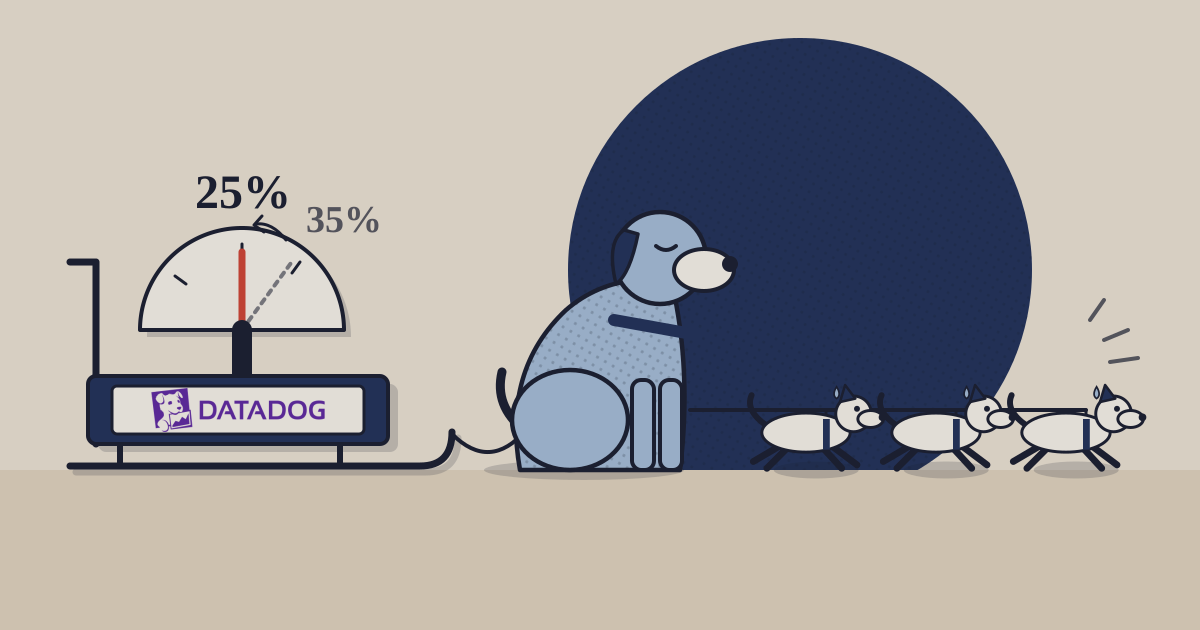
Datadog expects revenue of US$1.19–1.20bn in the October–December quarter, about what it booked in July–September (US$1.197bn, up 35% on a year earlier).1 The flat forecast rests on one assumption about one account. “Regarding our largest customer, our Q4 guidance contemplates their revenue at their minimum commitment,” the chief financial officer, David Obstler, said on the call on 4 November; that customer “reduced their usage in the third quarter” while staying above the minimum.3 Datadog did not name the customer. Its shares were down 12.5% at US$192.99 before the market opened, Investing.com reported,3 and closed at US$188.72, 14.4% below the previous day’s US$220.52.8
Datadog grew 35% a year; its guidance for the last quarter of 2026 implies about 25%
Datadog revenue by quarter, US$ million, and growth on the same quarter a year earlier, %, Oct–Dec 2025 to the Oct–Dec 2026 guidance
- Revenue (US$m)
- Change on a year earlier (%)
Show tableHide table
| Revenue (US$m) | Change on a year earlier (%) | |
|---|---|---|
| Q4 25 | 953.2 | 29.2 |
| Q1 26 | 1,006.4 | 32.2 |
| Q2 26 | 1,121.5 | 35.6 |
| Q3 26 | 1,197.1 | 35.2 |
| Q4 26 guide | 1,195 | 25.4 |
Source: Datadog quarterly results releases (8-K Exhibit 99.1), 10 Feb, 7 May, 6 Aug and 4 Nov 2026 · as of 4 November 2026 · Q4 26 is the midpoint of the US$1,190–1,200m guidance; growth is TechBag arithmetic on reported revenue
01What a minimum commitment is
Most of Datadog’s revenue comes from annual subscriptions. A customer commits to an amount of usage spread evenly over the months, or commits to an amount it draws down as it uses it, or pays monthly for what it uses. Usage above the committed amount is billed on top: each month in the first case, once the whole commitment is used up in the second.2 The commitment is the floor. “The customer can’t go below the minimum commitment, but can be various degrees above the minimum commitment,” Obstler said on the call; in the third quarter the largest customer “spent substantially above” it.3
Guiding at the minimum means counting only the part of that account’s revenue the contract guarantees. The 10-Q states the uncertainty: “future revenue can often vary significantly from past revenue” on drawdown contracts. Contracted revenue not yet recognised stood at US$3,847.7m on 30 September, against US$3,461.2m at the end of 2025, and Datadog expects to recognise substantially all of it within 24 months.2
02How much one account moves the forecast
“Excluding our largest customer, Q4 revenue growth implied in our guidance is in the low to mid-30s percent range,” Obstler said.3 Including it, US$1.19–1.20bn is 24.8% to 25.9% above the US$953.2m of October–December 2025.14
03How concentrated AI-native customers make the revenue
Datadog does not disclose its largest customer’s share of revenue. It discloses the cohort the customer belongs to: AI-native customers, “which cohort includes our largest customer”, added “high single digit percentage points” to revenue growth in the quarter to 30 September,2 and “approximately seven percentage points” in the quarter to 31 December 2025.7 Datadog now serves “over 850 AI customers, up from about 750 last quarter”, it said on the call, and revenue growth from all its other customers accelerated for a fifth straight quarter, to “the high 20% year-over-year”, the chief executive, Olivier Pomel, said.3 The 10-K names the pattern: customers in its cloud-native cohort in earlier periods, and now AI-native ones, “have rapidly increased their usage of our product and then optimized or may in the future optimize their usage”.7
What to watch in the February results: whether the largest customer’s revenue lands above its floor, which the guidance leaves out, and how the early renewals price. Pomel described early renewals by larger customers, “which include some other AI customers”; Obstler said they renewed “at higher levels than their previous commit, which is how they’re getting the volume discounts.”3
Sources
- Datadog, Datadog Announces Third Quarter 2026 Financial Results (8-K, Exhibit 99.1) — 4 November 2026
- Datadog, quarterly report on Form 10-Q, quarter to 30 September 2026 — 4 November 2026
- Investing.com, Earnings call transcript: Datadog Q3 2026 (Olivier Pomel, David Obstler), with the premarket move — 4 November 2026
- Datadog, Datadog Announces Fourth Quarter and Fiscal Year 2025 Financial Results (8-K, Exhibit 99.1) — 10 February 2026
- Datadog, Datadog Announces First Quarter 2026 Financial Results (8-K, Exhibit 99.1) — 7 May 2026
- Datadog, Datadog Announces Second Quarter 2026 Financial Results (8-K, Exhibit 99.1) — 6 August 2026
- Datadog, annual report on Form 10-K for 2025 (risk factors: the AI-native cohort) — 18 February 2026
- Nasdaq, DDOG historical prices (close, 3 and 4 November 2026) — 4 November 2026
Disclosure. TechBag is a software reseller: it earns a margin when a reader buys through it, including from vendors named here. The analysis is TechBag’s own; no vendor paid for or saw this piece before publication. Facts are labelled reported, TechBag count or our view.
Keep reading