SecurityThreats & vulnerabilitiesAnalysis
Keio Railway: data of 10.63m people possibly leaked, including 1.6m passport copies
Keio’s final report of 24 November on the ransomware found on 26 September: 12,000 staff confirmed leaked, 10.63m customers possibly, and why its hotels copied passports.

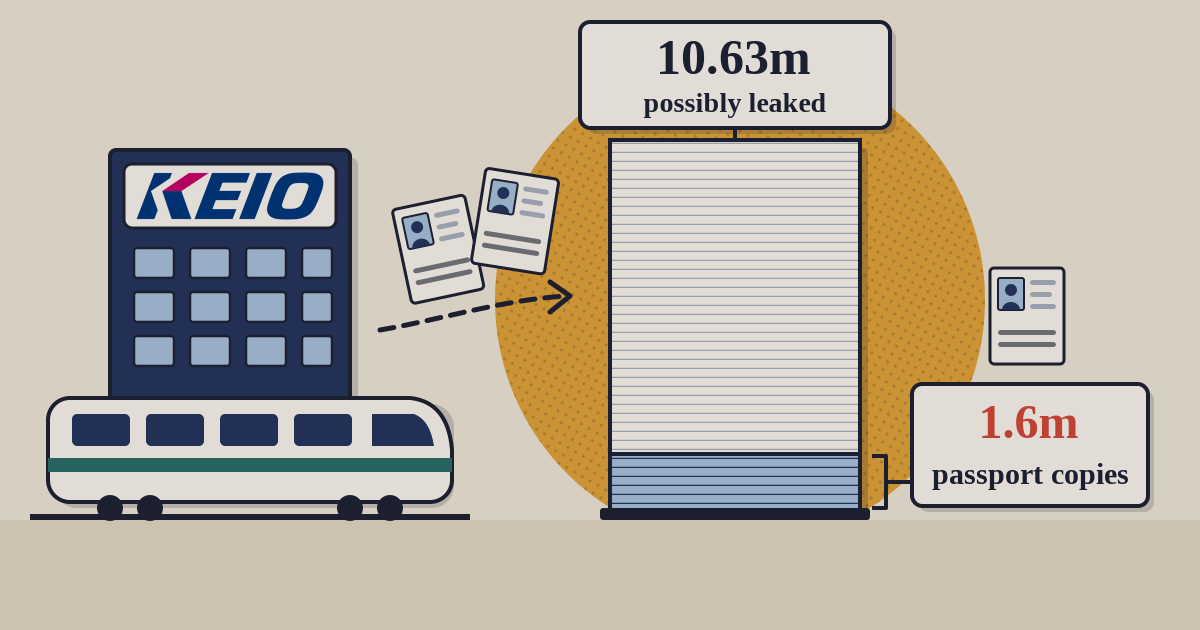
About 10.63m customers and business partners of Keio Corporation (京王電鉄), which runs the Keio and Inokashira rail lines and buses and owns hotels, a department store, supermarkets and property businesses, may have had their personal data leaked. Keio’s notice of 24 November separates two lists: what its investigators confirmed had leaked, and what they could not rule out. We read it for three answers: how large each list is, why a railway group’s servers held 1.6m copies of foreign passports, and what a guest who stayed at a Keio hotel can do now.1
10.63m
customers and partners whose data was possibly leaked
Keio, 24 Nov
1.6m
passport copies of overseas hotel guests among it, possibly leaked
Keio, 24 Nov
12,000
staff, former staff and families whose data is confirmed leaked
Keio, 24 Nov
59 days
from detection on 26 September to the final report on 24 November
TechBag count
01What Keio confirmed, and what it could not rule out
Keio detected the attack on its group network on 26 September, cut network connections at once, and sent a preliminary report to the Personal Information Protection Commission (PPC), Japan’s privacy regulator, because a leak was possible. Outside specialists then worked out the scope, and the final report went to the PPC on 24 November.1
The confirmed list is short: about 150 tenants of Keio’s rental property (names, addresses), about 160 job applicants (names, addresses, phone numbers, application documents) and about 12,000 employees, former employees and their dependants (names and HR data). The possibly leaked list is large: about 10.63m customers and partners, about 360,000 job applicants and about 77,000 employees, former employees and dependants. Keio says the same person can appear in more than one group, so the groups cannot simply be added, and the data held differs from person to person. For both lists it says no financial loss or other misuse has been confirmed so far.1
Keio confirmed leaks for about 12,300 people in three groups; for 10.63m customers and partners it says only possibly
People in each group named in Keio's final report, confirmed leaked vs possibly leaked, thousands, as of 24 November 2026
Source: Keio Corporation, notice of 24 November 2026 (Japanese) · as of 26 November 2026, 7:45pm IST · Keio: one person can appear in several groups, so the groups do not add up to a total of people.
02Inside the 10.63m: passports, card numbers and ID documents
For the customers and partners, Keio lists names, addresses, phone numbers, email addresses, My Number (Japan’s national ID number), passports (copies or numbers only), credit card numbers and identity documents, and its footnotes give the counts for the sensitive items. The largest by far is passports: about 1.6m records of overseas guests who stayed at the Keio Presso Inn chain, Keio Plaza Hotel, Keio Plaza Hotel Sapporo and Takayama Green Hotel. The counts are records (件), not people; a guest who stayed twice may appear twice.1
Passport copies of 1.6m overseas-guest records are the largest sensitive item; about 20,000 department-store card numbers too
Sensitive data types in the possibly leaked customer and partner set, records, as Keio's footnotes give them, 24 November 2026
Show tableHide table
| Data | Whose, as Keio describes it | Records | Status |
|---|---|---|---|
| Passport copies | Overseas guests at Keio Presso Inn, Keio Plaza Hotel, Keio Plaza Hotel Sapporo and Takayama Green Hotel | about 1,600,000 | Possibly leaked |
| Passport copies | Domestic customers of Keio Kanko (travel agency) | 65 | Possibly leaked |
| Passport numbers only | Overseas guests at Keio Prelia Hotel Kyoto (171); Keio Kanko domestic customers (771) | 942 | Possibly leaked |
| Identity documents | Received by Keio Fudosan and Livita in property sale and lease contracts | about 46,000 | Possibly leaked |
| Credit card numbers | Keio Credit Card, the Keio department store's own card | about 20,000 | Possibly leaked |
| Credit card numbers | Keio Plaza Hotel Executive Card applicants, March 2012 to January 2018 (382); Keio Closet Seiseki-Sakuragaoka users (109) | 491 | Possibly leaked |
| My Number card copies | Received by Keio Fudosan and Keio SC Creation | 6 | Possibly leaked |
| Staff My Number records | Residence certificates of Livita staff and families (116); card copies of Keio Fudosan staff (2) | 118 | Possibly leaked |
Source: Keio Corporation, notice of 24 November 2026, notes 1 to 6 (Japanese) · as of 26 November 2026, 7:45pm IST
Keio does not say whether the card numbers came with expiry dates or security codes, and it gives no nationality breakdown of the 1.6m passport records. It does not say how the attackers got in, and names no group; neither do we.1
03Why a Japanese hotel holds a copy of your passport
The passports are there because of a rule that began on 1 April 2005. Japan’s health ministry, which oversees hotels under the Hotel Business Act, says that for foreign nationals with no address in Japan the guest register must record nationality and passport number as well as name, address and occupation, and that to keep the register accurate the front desk asks to see the passport and takes a copy. The ministry gave two purposes: stopping the spread of infectious disease in hotels, and guest safety after terrorist incidents at home and abroad.5 Its multilingual notice for front desks puts it plainly: “The presentation and photocopying of passports is also required by the Government of Japan.”6
A 2005 rule turns every foreign guest's check-in into a stored passport copy
How a passport copy reaches a Japanese hotel's systems, from the health ministry's notices of March 2005 and the front-desk request
- 01
The rule
From 1 April 2005, the register for a guest with no address in Japan records nationality and passport number.
- 02
The front desk
The hotel asks to see the passport and takes a copy, to keep the register accurate.
- 03
The register
The copy is kept with the guest register; at a chain, that means the group’s systems.
- 04
The breach
At Keio, about 1.6m such records from four hotels are among the data possibly leaked.
Source: Ministry of Health, Labour and Welfare (March 2005; multilingual front-desk notice); Keio Corporation (24 Nov 2026) · as of 26 November 2026, 7:45pm IST
0459 days from encryption to the final report
Keio’s first notice, on 26 September, said the attack had been found in the early hours, that some group companies’ sales systems were affected, that no leak had yet been confirmed, and that trains were running normally. Police had been told.2 Over the following weeks smaller notices showed where the damage reached customers: the commuter-pass booking service and the personal-information inquiry form (30 September), the general inquiry form (5 October), and replies on group tickets and Keio Liner private compartments (13 October).34
Keio found the attack on 26 September and filed its final report 59 days later; hotel bookings are still stopped
Keio Corporation's ransomware incident, 26 September to 24 November 2026, as Keio's own notices give it
Show tableHide table
| Date | Event | Detail |
|---|---|---|
| 26 Sept 2026 | Attack found | Early hours: ransomware on group servers; network cut; police told; trains unaffected |
| 30 Sept 2026 | Services down | Commuter-pass booking and privacy inquiry form hit by system failure |
| 5 Oct 2026 | Inquiry form | General inquiry form still failing; replies delayed |
| 13 Oct 2026 | Group tickets | Replies on group tickets and Keio Liner compartments delayed |
| 24 Nov 2026 | Final report | Final report to the PPC; 10.63m possibly leaked, 12,000 confirmed |
Source: Keio Corporation, notices of 26 September, 30 September, 5 October, 13 October and 24 November 2026 (Japanese) · as of 26 November 2026, 7:45pm IST
The attack still affects one business directly: new bookings at Keio Presso Inn, its budget hotel chain, remain stopped because of the system failure, and Keio expects to reopen them during December.1 It is one of several large Japanese disclosures this autumn. Tokyo Shoko Research counted 215 leak incidents at listed companies in the ten months to October, as we reported in our count of Japan’s leaks7, and on 17 November Rakuten Securities said data of up to 4.47m accounts may have left a test system.8 Ransomware also stopped smart-meter output at Osaki Electric this month.
05What a Keio guest or customer can do
Keio asks three things of everyone: check card statements and call the card issuer about any charge you do not recognise; treat emails, text messages and calls that claim to come from Keio or its partners with suspicion; and do not open links or attachments in them. It will write individually to each person whose data is confirmed or possibly leaked as the facts are established. Its dedicated desk is 0120-089-925 (a free number inside Japan) and customer@keio.co.jp, 10am to 5pm Japan time on weekdays, and its privacy page explains how to ask for disclosure, correction or a stop to the use of your data.1
On its own side, Keio says it has run the response through a task force at group level, with lawyers and outside specialists advising, and that it will identify the weaknesses in its IT governance, review and strengthen its security measures, and publish anything further people need to know. It gives no date for that review and no description of the measures. The scope matters here: the notice covers 47 companies, from bus operators and a mountain railway to a staffing firm, a childcare-support company and an AI company, which suggests how much of the group shared the systems that were reached. That is our reading of the company list, not a statement Keio makes.1
Sources
- Keio Corporation, ランサムウェア攻撃による個人情報漏洩に関するお知らせとお詫び (notice on personal data leaked in the ransomware attack, in Japanese) — 24 November 2026
- Keio Corporation, ランサムウェア攻撃によるシステム障害に関するお知らせとお詫び (first notice of the system failure, in Japanese) — 26 September 2026
- Keio Corporation, 「定期券らくはや予約サービス」のシステム障害について and 「個人情報に関するお問合せフォーム」のシステム障害について (in Japanese) — 30 September 2026
- Keio Corporation, notices on the inquiry form (5 October) and group tickets and Keio Liner compartments (13 October), in Japanese — 5 and 13 October 2026
- Ministry of Health, Labour and Welfare, 日本国内に住所を有しない外国人の方の旅館・ホテル等における本人確認措置について (identity checks for foreign guests with no address in Japan) — March 2005
- Ministry of Health, Labour and Welfare, Request for producing of passports, etc. for identification purposes (multilingual front-desk notice) — undated; read 26 November 2026
- TechBag, Japan’s listed firms leaked 350m records in ten months, over 10 times last year (Tokyo Shoko Research data) — 13 November 2026
- TechBag, Rakuten Securities: up to 4.47m accounts’ data may have leaked from a test system — 21 November 2026
- MeitY, Digital Personal Data Protection Rules, 2025, G.S.R. 846(E), Rule 7 — 13 November 2025
- MeitY, commencement notification, G.S.R. 843(E) (copy on MediaNama) — 13 November 2025
Disclosure. TechBag is a software reseller: it earns when companies buy through it, including from vendors named here. The analysis is TechBag’s own; no vendor paid for or saw this piece before publication. Facts are labelled reported, TechBag count or our view. How the Journal works.
Keep reading