SecurityThreats & vulnerabilitiesNote
Five Mitel MiCollab flaws exploited with no login; CISA’s deadline is 28 November
Mitel’s advisory MISA-2026-0012 and CISA’s catalogue entries of 25 November: five no-login flaws in MiCollab’s conferencing component, the patched release, and what to do before the deadline.

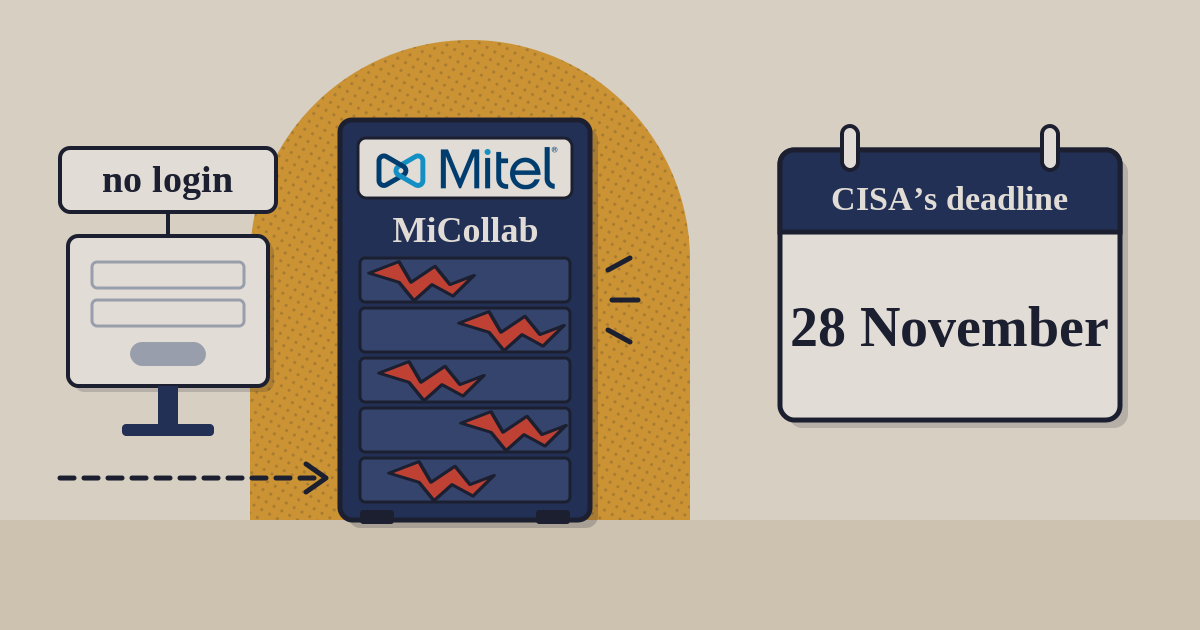
The US Cybersecurity and Infrastructure Security Agency added five flaws in Mitel’s MiCollab to its Known Exploited Vulnerabilities catalogue on 25 November, which means it has evidence they are being used in attacks. Federal agencies must fix four of them by 28 November and the fifth, CVE-2026-133311, by 9 December.2 Mitel’s advisory, first issued on 16 November, says each can be exploited by “an unauthenticated attacker”, and all five are in the Audio, Web and Video Conferencing (AWV) component. Releases 10.3 (10.3.0.18) and earlier are affected. The advisory does not mention exploitation.1
Two of the five flaws are critical: command injection scores 10.0, XML injection 9.0
CVSS 3.1 base score of each MiCollab AWV flaw in Mitel advisory MISA-2026-0012, as published on 24 November 2026
Source: Mitel, Product Security Advisory MISA-2026-0012, revision 2.0 · as of 26 November 2026, 7:30pm IST · Mitel rates the two highest critical and the other three medium
01What MiCollab is, and what the flaws allow
MiCollab is Mitel’s collaboration platform: voice, video, chat, SMS, web conferencing and team messaging from one system, on desk phones, softphones, a web client and a mobile app. It runs on premises, virtualised or in a public or private cloud, alongside Mitel’s MiVoice Business and MX-ONE call platforms.3
In Mitel’s descriptions, the command injection and the XML injection let an attacker run arbitrary commands on the system. The file-upload flaw lets one place arbitrary files on it, the authentication bypass lets one act inside the application, and the unauthorised-access flaw exposes sensitive information to anyone who knows a system-generated identifier. “Exploiting these vulnerabilities together can significantly amplify their impact,” Mitel writes.1
Show tableHide table
| CVE | Flaw, as Mitel describes it | Mitel severity (CVSS 3.1) | CISA due date |
|---|---|---|---|
| CVE-2026-133323 | Blind command injection | Critical (10.0) | 28 November |
| CVE-2026-133303 | XML injection using pre-staged content | Critical (9.0) | 28 November |
| CVE-2026-133275 | Arbitrary file upload | Medium (5.3) | 28 November |
| CVE-2026-133324 | Authentication bypass | Medium (5.3) | 28 November |
| CVE-2026-133311 | Unauthorised access with a known identifier | Medium (5.9) | 9 December |
The attacks appear to have begun before the fix. According to Accenture’s Apex Labs, as SecurityWeek reported, a web shell was placed on one victim’s systems on 15 November, a day before Mitel’s advisory, and it counted two victims; it has not linked the attacks to a known group.4 MiCollab has been on CISA’s list before: two path-traversal flaws, CVE-2024-41713 and CVE-2024-55550, were added on 7 January 2025.2
02What to do this week
- Patch. Mitel has a patch for release 10.3 (10.3.0.18): upgrade to that release and apply it, or upgrade to a later release. The steps are in Mitel Knowledge Base article KB000129195; customers without access go through their Mitel partner.1
- Close AWV to the internet if you cannot patch now. Mitel’s workaround is to restrict external access to the AWV component.1
- Look for compromise. CISA flags the two critical flaws for forensic triage, which under its directive BOD 26-04 means checking “whether the system is compromised”, not only patching it.2 5 Accenture urged the same, since servers may have been breached before the fix was installed.4
Sources
- Mitel, Product Security Advisory MISA-2026-0012: MiCollab Multiple Vulnerabilities — 16 November 2026, revised 24 November 2026
- CISA, Known Exploited Vulnerabilities catalogue (JSON feed, version 2026.11.25) — 25 November 2026
- Mitel, MiCollab Collaboration Software (product page) — read 26 November 2026
- SecurityWeek, Mitel MiCollab Zero-Days Exploited in Suspected AI-Assisted Attacks (reporting Accenture Apex Labs) — 26 November 2026
- CISA, BOD 26-04: Prioritizing Security Updates Based on Risk — read 26 November 2026
Disclosure. TechBag is a software reseller: it earns when companies buy through it, including from vendors named here. The analysis is TechBag’s own; no vendor paid for or saw this piece before publication. Facts are labelled reported, TechBag count or our view. How the Journal works.
Keep reading