Cloud & DevOpsNote
Microsoft 365 outage began with a July fix; over 80% of gateway servers went unresponsive
Microsoft’s preliminary report of 16 November: a July fix, lock contention on many-core servers, a Teams failover and a cascade that took more than 80% of gateway servers down.

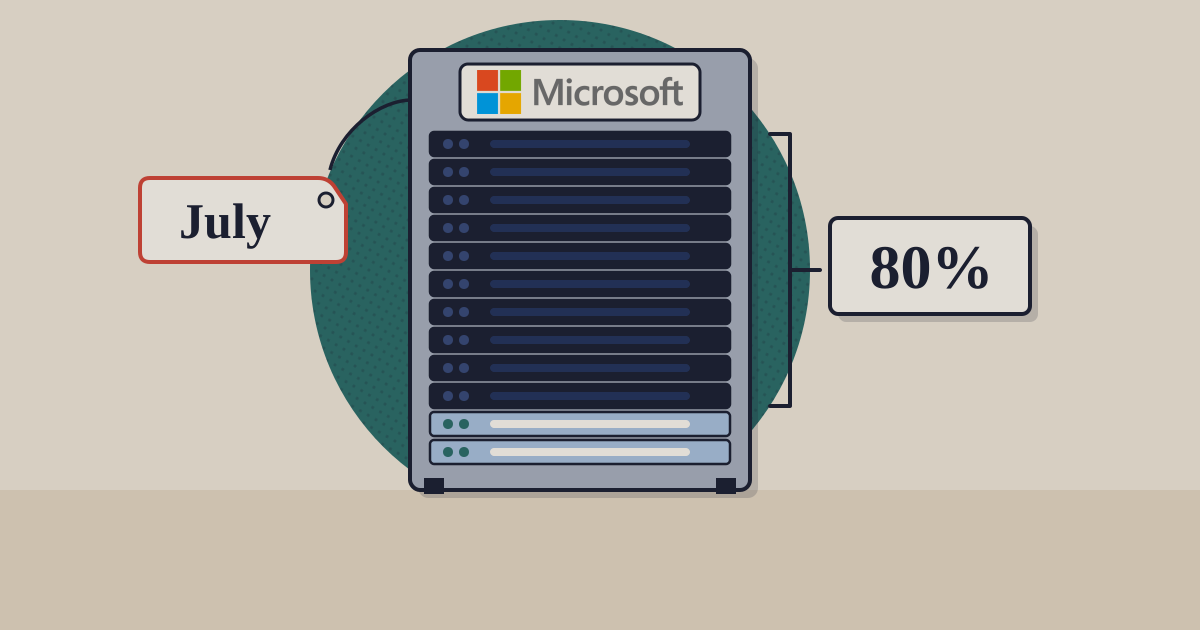
Last week’s Microsoft 365 outage began with a fix Microsoft started deploying in July. The change, made only for the networking gateway servers that front many Microsoft 365 services, carried a latent defect that ran worldwide for more than three months without impact. On 12 November extra load and missing capacity set it off, and at the low point more than 80% of the gateway’s servers were unresponsive.1 Microsoft released its preliminary post-incident report in the admin centre, under MO1550821 and EX1550543, at 05:48 UTC on 16 November (11:18am IST).2 Charles Lamanna of Microsoft posted an abridged version eighteen minutes later; it says the final review will follow later this week.1
July
when the defective fix began deploying worldwide
Microsoft
~14%
of gateway server capacity already out, from an unrelated issue
Microsoft
Under 2h
for the failure to spread across the whole fleet
Microsoft
80%+
of gateway servers unresponsive at the low point
Microsoft
01Three factors at one front door
The defect was lock contention inside an internal process: under certain load, servers became overwhelmed and stopped responding. Microsoft says neither the defect nor the fix applies to broader Windows deployments. Its load tests had not caught it because they used a different traffic and hardware mix, and “tended to focus on our weaker hardware SKUs with fewer cores”; the contention is worse on newer machines with more cores.1 In plain terms, a lock lets one thread at a time into a piece of shared work while the rest queue; more cores means more threads in that queue.
Two ordinary events then lined up. Microsoft 365 runs two independent gateway systems so services can fail over between them, and about fifteen hours before the outage Teams moved from the alternative gateway to the “primary” one that also carries Exchange Online, adding load and changing its traffic pattern. At the same time nearly 14% of that gateway’s capacity was out of service after an unrelated issue the day before. Either alone was within the headroom; together, during peak traffic in the United States, requests built up until servers stopped responding.1 The Register, reading the admin-centre report, puts the Teams failover at 01:07 UTC on 12 November and the first alert from Microsoft’s connectivity monitor at 16:03 UTC, with the first support case at 16:33.6
02Why it spread, and why it took a day
The safety net spread it. When a server drops out, traffic management sends its users to other healthy endpoints; here that pushed the same load onto fewer servers, which hit the same defect, server after server. In under two hours the whole fleet was affected. The gateway is built from thousands of “capacity units” grouped into regions, but “due to a separate issue” the bulkheads between them did not hold, so the failure went global.1 Teams, OneDrive, SharePoint and the Office apps could move to the other gateway, which is why Teams chats and meetings mostly worked. Exchange Online cannot.1
Fifteen hours passed between the first alert and the fix that undid the July change
Microsoft 365 networking-gateway outage, 12 to 16 November 2026, in UTC (IST in each detail)
Show tableHide table
| Date | Event | Detail |
|---|---|---|
| 12 Nov, 01:07 UTC | Teams fails over | Onto the gateway Exchange uses; 6:37am IST |
| 12 Nov, 16:03 UTC | Monitor alerts | US peak traffic; 9:33pm IST |
| 12 Nov, 17:54 UTC | First public post | Exchange mailboxes fail; 11:24pm IST |
| 13 Nov, 00:30 UTC | Cause narrowed | Connection handling blocked; 6:00am IST |
| 13 Nov, 07:20 UTC | Fix applied | Reverts the defective change; 12:50pm IST |
| 13 Nov, 16:10 UTC | Healthy again | 9:40pm IST |
| 14 Nov, 06:09 UTC | Restored for all | Remaining customers and regions; 11:39am IST |
| 16 Nov, 05:48 UTC | Preliminary report | In the admin centre; 11:18am IST |
Source: Microsoft (status posts on X, abridged preliminary report); admin-centre times as read by The Register · as of 16 November 2026, 11:30pm IST
Recovery was slow for two reasons Microsoft names. Servers brought back were swamped by waiting traffic and failed again, and automated recovery was not designed for a fleet this broadly unresponsive. And because the change was months old, rollback, flighting and feature flags could not quickly revert it. Engineers wrote an update restoring the earlier code path and applied it to groups of servers, sometimes more than half a region at a time.1 Microsoft said service was restored to the remaining customers and regions at 06:09 UTC on 14 November.3
03An alarm that went by email
One consequence reached beyond inboxes. Phantasialand told the German broadcaster WDR that, because of the outage on Friday 13 November, no mail arrived, so no one saw that the safety system of its sauna area had already raised the alarm by email: a faulty automatic dosing system had pumped too much chlorine into the pool at its Hotel Ling Bao in Brühl. Fifteen guests were affected; four were taken to hospital, and one was kept in for observation.7
Sources
- Charles Lamanna (Microsoft) on X: abridged preliminary post-incident report on the Microsoft 365 networking gateway outage — 16 November 2026, 06:06 UTC
- Microsoft 365 Status on X: Preliminary Post-Incident Report released under MO1550821 and EX1550543 — 16 November 2026, 05:48 UTC
- Microsoft 365 Status on X: service restored to the remaining impacted customers and regions — 14 November 2026, 06:09 UTC
- Microsoft 365 Status on X: first post, EX1550543 — 12 November 2026, 17:54 UTC
- Microsoft 365 Status: public status API (status.cloud.microsoft) — status authored 14 November 2026, 05:42 UTC
- The Register: Microsoft blames monster email outage on software defect introduced in July fix — 16 November 2026, 11:15 UTC
- WDR: Chlorunfall im Phantasialand: 15 Gäste verletzt (in German) — 14 November 2026, updated 16 November 15:15 CET
Disclosure. TechBag is a software reseller: it earns when companies buy through it, including from vendors named here. The analysis is TechBag’s own; no vendor paid for or saw this piece before publication. Facts are labelled reported, TechBag count or our view.
Keep reading