Buying software in IndiaAnalysis
UPI’s merchant fee will fund ₹300 per QR code and ₹750 per soundbox
NPCI’s circular of 11 November: how 5% of every bank’s and app’s share of UPI’s coming 0.4% merchant fee will pay for QR codes, soundboxes and small shops’ payments for three years.

UPI has cost merchants nothing since January 2020.10 When the charge begins, every shop that takes UPI, every bank that signs one up and every payments app will want to know who pays, who is paid, and on what terms. NPCI has now written down the second half of that answer in a 22-page circular to its member banks. We read it alongside the finance ministry’s statement of the fee, NPCI’s affidavit to the Supreme Court as it was reported, and what the listed payment companies have told their shareholders.
02Three pots: new shops, small payments, smaller towns
The fund is divided 30%, 50% and 20% between three components, and “funds allocated for one component cannot be used for another”. If claims on a component exceed its money, eligible banks are paid pro rata, and anything unused is carried into the next year within the same component.1
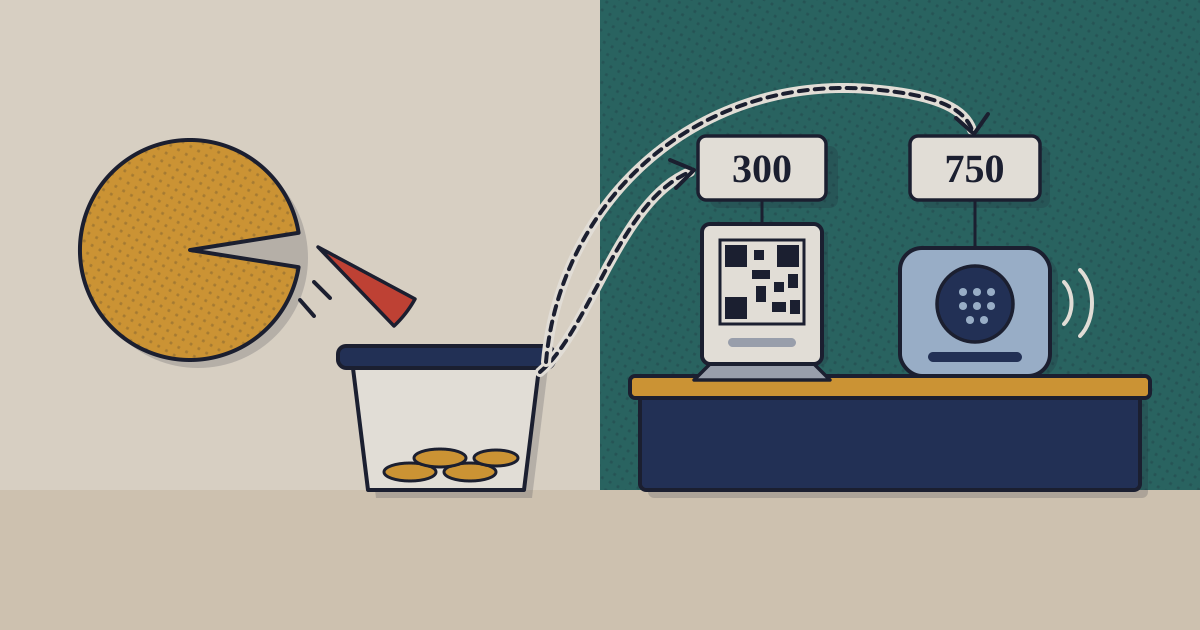
- Component A, new merchants (30%). ₹300 for each physical QR code and ₹750 for each soundbox at a small merchant signed up during the scheme. The merchant must make at least 25 eligible transactions in any two months of each quarter and take at least ₹5,000 a month, and must not have been funded for the same device by this or any other scheme. Devices already funded through bodies such as NABARD are excluded.
- Component B, small payments (50%). 0.03% of the value of eligible transactions at new and existing small merchants, if the bank keeps those merchants’ transaction volume growing at least 5% a quarter. Payments at merchants in the targeted areas earn 50% more.
- Component C, growth in smaller towns (20%). 0.20% of the increase in eligible transaction value in the targeted areas over the previous quarter, on top of Component B.
An eligible transaction is “a successfully settled UPI transaction with value ≤ ₹2,000 at a Small Merchant”. The targeted areas are Tier-3 to Tier-6 towns by Census classification, the north-eastern states, Jammu and Kashmir, and Ladakh. Shops in Tier-1 and Tier-2 cities qualify only if they are covered by a notified central scheme such as PM SVANidhi or PM Vishwakarma. NPCI’s own worked examples: 1,000 QR codes and 200 soundboxes earn ₹4,50,000; ₹50 crore of eligible payments in a quarter earns ₹1,50,000, or ₹1,80,000 if 40% of it is in targeted areas; a ₹10 crore rise in targeted areas earns another ₹2,00,000.1
Half the fund pays for small payments; 30% pays for new QR codes and soundboxes
Share of the UPI Vyapaar Saksham fund by component, % of the total, for the scheme's three years
- B: small payments, 0.03% of value50% 50%
- A: new merchants, ₹300 a QR, ₹750 a soundbox30% 30%
- C: growth in targeted areas, 0.20%20% 20%
Show tableHide table
| Value (%) | Share | |
|---|---|---|
| B: small payments, 0.03% of value | 50 | 50% |
| A: new merchants, ₹300 a QR, ₹750 a soundbox | 30 | 30% |
| C: growth in targeted areas, 0.20% | 20 | 20% |
Source: NPCI/UPI/OC No. 242/2026-27, Annexure sections 6 and 6.4 · as of 17 November 2026
The circular states what NPCI expects each year: 6 to 10 million new physical QR codes, 0.5 to 1 million new soundboxes, and 30% to 50% annual growth in transaction volumes at existing small merchants. It reviews the scheme every six months and may extend it to more regions and merchant categories.1
03The new rate is a fifth of the government's old one
Until now the government has paid. Its scheme for 2024-25, approved by the Cabinet on 19 March 2025 with an outlay of ₹1,500 crore, paid acquiring banks 0.15% of the value of UPI merchant payments up to ₹2,000 at small merchants. Eighty per cent of each claim was paid without conditions; the rest depended on technical declines below 0.75% and uptime above 99.5%. The incentive was paid to the merchant’s bank “and thereafter shared” with the payer’s bank, the PSP bank and the apps. The government’s UPI payouts were ₹957 crore in 2021-22, ₹1,802 crore in 2022-23 and ₹3,268 crore in 2023-24.10
NPCI’s affidavit, as LiveLaw reported it, cites Parliament’s Standing Committee on Finance, which found that the budget support for zero MDR covered only 11% of the industry’s actual costs. Answering the committee, the finance ministry put the industry’s operating costs at ₹20,700 crore, against ₹2,000 crore allocated for 2026-27.3 Component B pays on the same kind of payment, a small merchant’s UPI payment of up to ₹2,000, at a fifth of the 2024-25 rate, and only while the bank’s small-merchant volumes grow 5% a quarter.1
On ₹50 crore of small payments, the new fund pays a bank ₹1.5 lakh; the government's 2024-25 rate paid ₹7.5 lakh
Incentive to an acquiring bank on ₹50 crore of small-merchant UPI payments up to ₹2,000 in one quarter, ₹ lakh
Source: NPCI OC 242/2026-27, 11 November 2026; Cabinet decision (PIB), 19 March 2025 · as of 17 November 2026 · TechBag arithmetic at each stated rate; the 2024-25 figure is before its 20% performance conditions; Component C can add 0.20% of growth
Neither the circular nor the ministry’s release says whether the government’s own incentive continues once the fee starts. The two schemes define a small merchant in their own documents, so the payments they cover need not be identical.12
04Who pays, who does not, and two meanings of 'small'
The fee schedule is the finance ministry’s, from 15 September. Payments between people stay free at any amount, and so do merchant payments up to ₹2,000. Small merchants, “including street vendors receiving up to ₹1 lakh per month through UPI QR codes under the Person-to-Person-Merchant (P2PM) category”, pay nothing on any payment. Above ₹2,000 the fee is 0.4%, capped at ₹300 from ₹75,000. Railways, telecoms, insurance, fuel and farm inputs pay a flat ₹5, and capital-market payments 0.02%, capped at ₹300. “Banks have been advised to ensure that merchants do not pass MDR charges on to customers,” and apps may not add platform fees. The ministry says about 4% of merchant transactions will attract the fee.2 The ₹2,000 line comes from the ministry’s notification of 14 September under Section 10A of the Payment and Settlement Systems Act, which bars charges on UPI payments up to that amount.5
Customers pay nothing; merchants pay only above ₹2,000; every bank and app gives 5% of its share
Who is charged what under UPI's merchant fee and the Vyapaar Saksham fund, as published in September and November 2026
Open the table for the full schedule:
Show tableHide table
| Payment or participant | What is charged | Set by |
|---|---|---|
| Person to person, any amount | Nothing | Ministry of Finance |
| Merchant payment up to ₹2,000 | Nothing; counts towards the bank's incentives at a small merchant | Ministry of Finance; NPCI OC 242 |
| P2PM small merchant, up to ₹1 lakh a month by UPI QR | Nothing, on any payment | Ministry of Finance |
| Merchant payment above ₹2,000 | 0.4%, at most ₹300 (reached at ₹75,000) | Ministry of Finance |
| Railways, telecoms, insurance, fuel, farm inputs, above ₹2,000 | ₹5 flat | Ministry of Finance |
| Mutual funds, securities, brokers | 0.02%, at most ₹300 | Ministry of Finance |
| Customer | Nothing; no platform fee from apps | Ministry of Finance |
| Each bank, PSP and app receiving a fee share | 5% of its share to the fund, except industry programmes and capital markets | NPCI OC 242 |
Source: Ministry of Finance (PIB), 15 September 2026; NPCI OC 242/2026-27, 11 November 2026 · as of 17 November 2026
“Small” means two different things. The exemption from the fee follows monthly UPI receipts: up to ₹1 lakh a month on P2PM terms. The scheme follows annual turnover: “Merchant with an annual turnover of up to ₹40 lakh during the previous financial year”.21 A shop can be outside the first and inside the second. One with ₹30 lakh of turnover that receives more than ₹1 lakh a month through UPI is not covered by the P2PM exemption, so its payments above ₹2,000 can carry the fee, while its payments up to ₹2,000 still count towards its bank’s incentives.
The ₹40 lakh line appears three times in the circular: in the preamble, the definitions and the claim format. NPCI’s counter-affidavit of 3 November, as LiveLaw and ThePrint reported it, had proposed the fund for merchants with turnover of up to ₹20 lakh.134 The circular is the later document, and the one banks claim under. It also deals with splitting: a large bill paid in pieces of ₹2,000 or less would avoid the fee and earn an incentive, and the circular says the scheme “shall not reward artificial transaction splitting”. Annexure VI lists it as a risk met by “pattern analytics and threshold monitoring”.1
05What banks must report, what the companies say, and the road so far
The scheme pays acquiring banks, which sign up merchants “either directly or indirectly though Payment Aggregator”; it does not say how a bank shares the money with an aggregator or a merchant. Claims are certified by the bank’s internal and external auditors, and the signatory authorises NPCI to recover any excess from the bank’s settlement account at the Reserve Bank. Each transaction must carry the merchant’s geocode, a merchant identifier derived from the mobile number for small merchants, and the merchant’s type and genre, and device reports must place each terminal within 1 km. If a bank does not send these, “the corresponding transactions shall not be considered for incentive computation”. Payment aggregators that capture locations must pass them to their banks.1
The listed companies have spoken about the fee, not yet about the fund. Paytm told shareholders on 26 October that, “based on the proposed cap of 0.4% MDR on select payments (non-industry merchants) for payments above ₹2,000”, it expects “an indicative uplift of approximately 2.5 bps” in its payments processing margin, now “comfortably above 4 bps”, and expects the outcome to stabilise two to three quarters after the start. “We do not depend on UPI MDR for profitable growth,” it said. Its Soundbox is deployed at 1.64 crore storefronts.7 On its call, chief financial officer Madhur Deora put 2.5 basis points on ₹28 lakh crore of GMV at “slightly more than Rs 700 crore”, MediaNama reported.8 MobiKwik’s chief executive Upasana Taku told Business Today Television she expects “at least 150 crore” of extra revenue in 2027-28; PhonePe’s Sameer Nigam told CNN-News18, “We are comparing it to free.”9 We found no statement from Google Pay.
Two months from fee schedule to fund rules; the start date is still to be notified
Steps in UPI's merchant-fee framework, 14 September to 11 November 2026
Show tableHide table
| Date | Event | Detail |
|---|---|---|
| 14 Sept 2026 | ₹2,000 line notified | UPI payments up to ₹2,000 protected from charges |
| 15 Sept 2026 | Fee schedule announced | 0.4% above ₹2,000, capped at ₹300; NPCI circular the same day |
| 28 Sept 2026 | Supreme Court refuses a stay | Asks the Centre, RBI and NPCI to explain |
| 13 Oct 2026 | 15 October start deferred | To after Diwali, date to be notified |
| 26 Oct 2026 | Paytm: about 2.5 bps uplift | Margin effect settles 2–3 quarters after start |
| 3 Nov 2026 | NPCI affidavit | Fund for merchants up to ₹20 lakh, as reported |
| 11 Nov 2026 | Vyapaar Saksham circular | ₹40 lakh merchants; three years from the fee's start |
Source: Ministry of Finance (PIB); NPCI; LiveLaw; PTI; One97 Communications · as of 17 November 2026
On 13 October NPCI said its UPI and Services Steering Committee had decided, “keeping in mind the festive season”, that the fee “shall be implemented immediately post Diwali on a date to be notified separately”, PTI reported.6 NPCI told the Supreme Court that implementation had since been postponed, LiveLaw reported, and the petition challenging the fee, Anjan Datta v. Union of India, is pending after the court refused a stay on 28 September.35 No date had been notified by 17 November. The scheme’s three years start from it.
Sources
- NPCI: NPCI/UPI/OC No. 242/2026-27, UPI Vyapaar Saksham Scheme for Promoting UPI Acceptance among Small Merchants, with Annexure V1.0 — 11 November 2026
- Ministry of Finance (PIB): UPI Continues to Remain Free for Peer to Peer Transactions and 96% of Merchant Transactions — 15 September 2026, 6:45pm
- LiveLaw: Merchants Cannot Pass On UPI Charges To Customers, MDR Necessary To Sustain UPI Ecosystem: NPCI Tells Supreme Court — 5 November 2026 on NPCI's counter-affidavit of 3 November
- ThePrint: MDR charges needed to sustain UPI ecosystem, merchants can't pass them to customers, NPCI tells SC — 6 November 2026
- LiveLaw: Supreme Court Asks Centre To Explain Decision To Levy Charges On UPI Transactions, Refuses Stay — 28 September 2026
- DT Next (PTI): NPCI defers levy of MDR on UPI transactions; no new date announced for implementation — 13 October 2026
- One97 Communications (Paytm): Earnings Release Q2 FY2027 (copy hosted by MediaNama) — 26 October 2026
- MediaNama: UPI MDR set to deliver Rs 700 crore windfall for Paytm — 29 October 2026
- MediaNama: PhonePe, Paytm, MobiKwik back UPI MDR above Rs 2,000 — 18 September 2026
- Cabinet (PIB): Cabinet approves Incentive scheme for promotion of low-value BHIM-UPI transactions (P2M) — 19 March 2025
- NPCI: UPI circulars list (OC 237 of 2026-27 listed as "Please get in touch with your bank") — as listed on 17 November 2026
Disclosure. TechBag is a software reseller: it earns when companies buy through it, including from vendors named here. The analysis is TechBag’s own; no vendor paid for or saw this piece before publication. Facts are labelled reported, TechBag count or our view.
Keep reading