eMudhra’s TLS exit costs ₹20–23 crore of income, 2.5 to 3 times its TLS business
eMudhra’s earnings call of 5 November: why leaving TLS costs more than TLS earned, guidance cut to ₹800 crore and ₹125 crore, and what browsers do after 16 November.

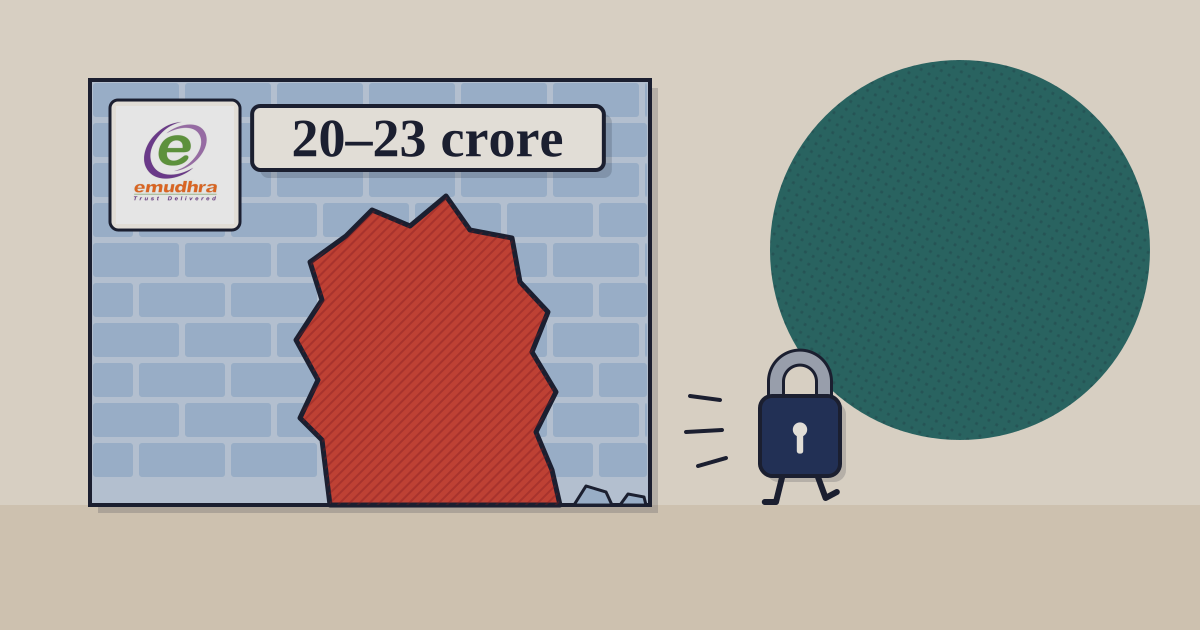
Leaving the TLS certificate business will cut eMudhra’s total income for the year to March 2027 by about ₹20–23 crore and its profit after tax by about ₹10–12 crore, mostly in the second half, its executive chairman V. Srinivasan told analysts on 5 November. The Bengaluru company lowered its guidance for the year from about ₹825 crore of revenue and ₹137 crore of profit to about ₹800 crore and ₹125 crore.1 The TLS business itself was “around ₹8 crore”, ₹4 crore of it in the US, and about 1% of revenue.13 So the exit costs between two and a half and three times what TLS brought in.
₹20–23 cr
total income the TLS exit takes off the year to March 2027
eMudhra
₹10–12 cr
profit after tax lost, largely in October–March
eMudhra
₹8 cr
the whole TLS business; ₹4 crore of it in the US
eMudhra
₹800 cr
revenue guidance for the year, from about ₹825 crore
eMudhra
01Why the loss reaches beyond TLS
Only one customer was directly affected, eMudhra says: a university federation in the US that used both its CertiNext certificate-management software and its emSign TLS certificates. It is staying on CertiNext and has asked eMudhra to supply TLS certificates from another provider on a subcontract. What eMudhra loses is new business: two or three TLS deals it is walking away from, which the chairman put at under US$1m, perhaps US$600,000–700,000, and a reputational effect he expects to be confined to the US and “a little bit” of the Middle East, for about two quarters. In India, he said, revenue is not likely to be affected at all.1 Other customers who thought they might be exposed were moved to certificates from Sectigo or other providers.1
Why leave rather than rebuild: free 90-day certificates and automatic renewal over the ACME protocol mean “nobody is willing to pay money to get the certificate”, the chairman said, calling TLS a declining business.1 The rest of the company grew. Total income for July–September was ₹209.3 crore, up 19.6% on a year earlier, and profit after tax ₹33.4 crore, up 26.3%; enterprise solutions grew 36% and are now 66% of revenue.2
The TLS exit takes eMudhra’s profit-growth target from 25% to 14%
eMudhra guidance for the year to March 2027 as growth on the year to March 2026, %, first guidance and guidance of 5 November
- First guidance (₹825 cr, ₹137 cr)
- Guidance of 5 November (₹800 cr, ₹125 cr)
Show tableHide table
| First guidance (₹825 cr, ₹137 cr) | Guidance of 5 November (₹800 cr, ₹125 cr) | Change | |
|---|---|---|---|
| Revenue growth | 15.7 | 12.2 | -3.5 pts |
| Profit after tax growth | 24.5 | 13.6 | -10.9 pts |
Source: eMudhra, Q2 FY27 earnings call (5 November 2026) and Q2 results press release (4 November 2026) · as of 9 November 2026 · Growth is our arithmetic on FY26 total income of ₹713.2 crore and profit of ₹110.0 crore
The new figures also say something about the second half. eMudhra booked ₹401.8 crore of total income and ₹65.4 crore of profit in April–September.2 Reaching ₹800 crore and ₹125 crore leaves about ₹398 crore and ₹60 crore for October–March: a second half slightly smaller than the first.
02What the browsers’ code says about the 16 November cut-off
Chrome’s root store, changed on 5 November, gives emSign Root CA – G1 a constraint date of 23:59:59 UTC on 16 November, 5:29am IST on 17 November: a certificate under it is trusted only if its Certificate Transparency timestamps are no later than that.4 Mozilla’s change, pushed the same day, sets the same second as G1’s TLS “distrust-after” date, checks the timestamps so a certificate cannot be backdated, and removes the root’s email (S/MIME) trust. Certificates issued on or before the cut-off keep working until they expire.5 Apple’s note of 9 November blocks the compromised G3 intermediates and removes G1 only from the certificate file that macOS’s command-line tools read.6
Sources
- eMudhra, transcript of the Q2 FY2027 earnings conference call (filed with BSE and NSE) — call 5 November 2026; filed 9 November 2026
- eMudhra, press release on unaudited results for the quarter and half year ended 30 September 2026 — 4 November 2026
- eMudhra, eMudhra to Exit global SSL/TLS Certificate Business (press release) — 22 October 2026
- Chromium, Chrome Root Store root_store.textproto: constraint on emSign Root CA - G1 (commit 772326f1d2) — 5 November 2026
- Mozilla Bugzilla 2089115, Remove email trust and set TLS distrust-after to 2026-11-16 23:59:59 UTC for emSign Root CA - G1 — 4–5 November 2026
- Apple Support, About the compromised eMudhra intermediate CAs — 9 November 2026
Disclosure. TechBag is a software reseller: it earns when companies buy through it, including from vendors named here. The analysis is TechBag’s own; no vendor paid for or saw this piece before publication. Facts are labelled reported, TechBag count or our view.
Keep reading