SecurityRisk & complianceAnalysis
Fireworks AI’s breach reached 149,346 Uber drivers, Notion and Cursor
Uber’s state filings and the bulletins of Fireworks, Notion, Cursor and Barracuda, 9 October to 13 November: how access handed to AI vendors became the way in.

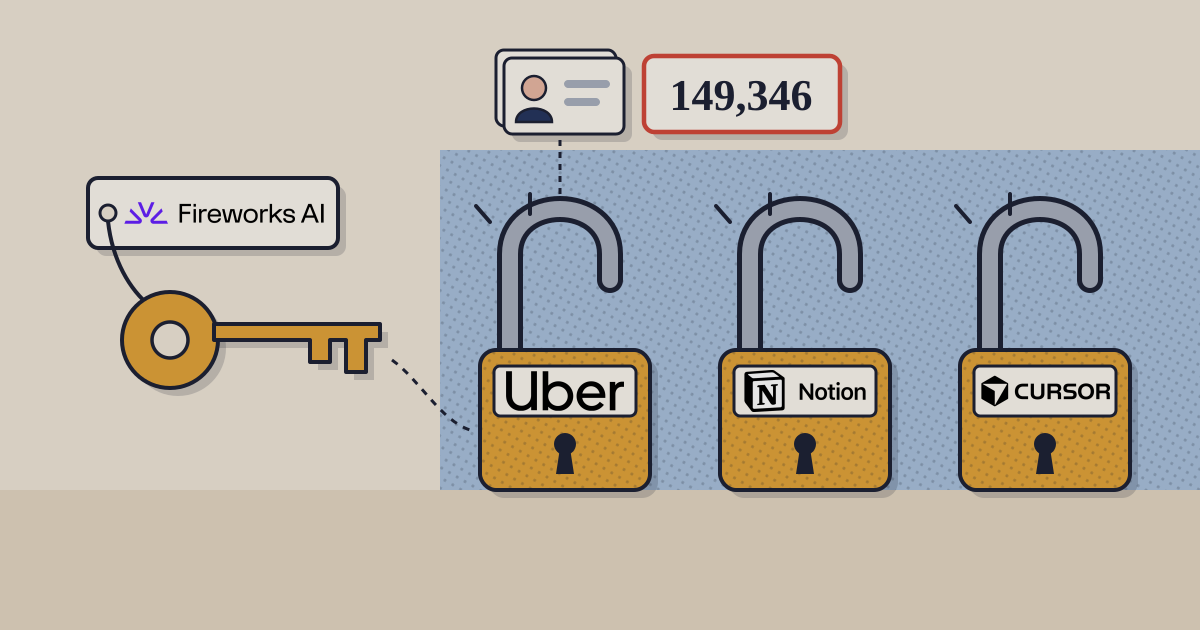
Companies give AI vendors two things: data to run models on, and keys to reach it. Between 9 October and 13 November, five companies disclosed what happened when that access was used by someone else. A security or procurement head who has signed up an AI vendor this year needs to know how the access was used, what each customer lost, and what each says it changed. We read Uber’s state filings and its letter to those affected, the bulletins of Fireworks, Notion, Cursor and Barracuda, and Railway’s incident report.
01Uber: 149,346 people, reached with the vendor’s own credentials
Uber reported the breach to Oregon’s Department of Justice on 10 November. Its entry gives 149,346 people affected, a breach date of 1 October, 9 October as the day Uber discovered it, and 10 November as the day notices went out.1 Its California entry gives the breach date as Wednesday, 7 October.2
149,346
people Uber notified, in its filing with Oregon's Department of Justice on 10 November
Rhode Island’s 1,873 residents, the one state count in Uber’s letter, are about 1.25% of them.3
The letter, dated 10 November, says how. “On October 9, 2026, a service provider notified Uber that an unauthorized third party had compromised the service provider’s internal credentials and used them to access Uber’s account with the service provider.” Uber “immediately severed data connections with the service provider”, and on 13 October its investigation found that the intruder had used those credentials “to access Uber data connected to the service provider”. Uber offers credit monitoring through Cyberscout, to be taken up within 90 days, and says it has “not identified any misuse” of the data.3
The letter leaves the data fields as a template placeholder. TechCrunch, which read the notices filed in several states, reports names, addresses, dates of birth and driver’s licence numbers. An Uber spokesperson told it: “The notices to drivers are in relation to a security incident impacting one of our third-party vendors, Fireworks.ai, which had access to some Uber data.” Uber also said, as TechCrunch reports it, that it had alerts set for unauthorised access to its Fireworks environment, but because the intruder used Fireworks’ own internal credentials, “no alerts were triggered”.4
Uber's data was opened with its vendor's own credentials, so Uber's alerts did not fire
The access chain in Uber's notice letter and statements, 1 October to 10 November 2026
- 01
Data at the vendor
Uber kept an account with Fireworks, and Uber data was “connected to” it, in the letter’s words.
- 02
The vendor’s keys
An outsider compromised Fireworks’ internal credentials. Fireworks found the misuse on 6 October.
- 03
Inside Uber’s account
Those credentials opened Uber’s account. Uber’s alerts for unauthorised access did not trigger, Uber said.
- 04
Letters
Told on 9 October, confirmed on 13 October; notices to 149,346 people from 10 November.
Source: Uber notice letter of 10 November 2026; Oregon DOJ breach list; Uber to TechCrunch, 16 November 2026 · as of 17 November 2026
02One vendor, at least three customers, five weeks
Fireworks found “unauthorized use of internal Fireworks credentials” at 9am Pacific time on 6 October, began notifying customers the next morning and published its first bulletin on 9 October. At first it reported that environment variables, “including API keys and tokens stored as secrets”, had been captured from evaluation jobs in “a limited number of customer accounts”. It warned those customers that “removing a stored secret alone does not invalidate the underlying credential”: a key held at Fireworks for another service had to be revoked at that service.5
Its update of 9 November widened the picture: account and billing information, and for a limited set of accounts secrets, datasets and incomplete model weights. It also described a second way in. A third-party cloud provider hosting Fireworks’ research machines had an incident on 23 October; on 24 October the intruder used it to reach Fireworks’ development machines and run a workload “that led to additional customer data impact”. Fireworks says it has detected no further successful access to the platform customers use since 25 October, and no impact on its inference service, which keeps no data by default.6
Notion used Fireworks for classification jobs behind its Insights feature and to serve open-weight models. Fireworks told it on the evening of 2 November that a small set of data, synthetic test data, had been accessed; on 6 November that customer data might have been; and on 8 November confirmed it. The new set held Notion AI chat transcripts from fewer than 1% of workspaces, which for most were “unattributable”: not labelled with a user or workspace.7 Cursor’s account, which we covered in our Note of 16 November, begins with “an access key we had issued to Fireworks” that “was exposed by Fireworks”, and ends with a fake extension on its marketplace cache.8
Fireworks found the intrusion on 6 October; its customers were still learning what was taken five weeks later
Dates in the bulletins and filings of Fireworks AI, Uber, Cursor and Notion, 1 October to 10 November 2026
Show tableHide table
| Date | Event | Detail |
|---|---|---|
| 1 Oct 2026 | Uber’s breach date | As filed in Oregon; 7 October in California |
| 6 Oct 2026 | Fireworks finds misuse | Its own internal credentials, used by an outsider |
| 9 Oct 2026 | Uber told | Severs its data connections to the vendor |
| 13 Oct 2026 | Uber confirms | Its data was accessed with the stolen credentials |
| 29 Oct 2026 | Fake extension at Cursor | About 11 hours; at most 5,000 users |
| 2 Nov 2026 | Notion told | Cuts Fireworks off by the next morning |
| 8 Nov 2026 | Notion’s transcripts confirmed | Fewer than 1% of workspaces |
| 10 Nov 2026 | Uber’s letters | 149,346 people, in its Oregon filing |
Source: Oregon DOJ; Uber letter; Fireworks AI bulletins of 9 October and 9 November; Cursor, 13 November; Notion, 9 November 2026 · as of 17 November 2026
What each customer had shared with Fireworks, and what it says was taken:
Show tableHide table
| Customer | What it shared with Fireworks | What was taken, as stated | Scale, as stated |
|---|---|---|---|
| Uber | Data connected to its account with the vendor | Names, addresses, dates of birth, driver’s licence numbers (TechCrunch) | 149,346 people notified |
| Notion | Insights classification jobs; open-weight model serving | Notion AI chat transcripts, mostly not tied to a user or workspace | Fewer than 1% of workspaces |
| Cursor | A key to a read-only bucket of coding-agent traces | Traces, unredacted credentials in a few, then support data and archived code | Traces of fewer than 0.05% of users; fake extension to at most 5,000 |
| Other Fireworks customers | Secrets in evaluation jobs; account and billing data | API keys and tokens; billing data; some datasets and incomplete models | “A limited number of customer accounts” |
03Barracuda: a different AI vendor, and a key nobody retired
Barracuda, the security company, describes the same kind of opening with a different vendor. “As part of a previous project, we provided a cloud access key to a third-party vendor.”9
“We did not retire the key when the vendor — a company working in AI — finished that work. That is on us.”
Its advisory, updated on 13 November, says the key sat in a configuration file in the vendor’s GitHub repository, exposed when the vendor’s development environment was compromised in October.10 The first call with it came at 04:33 on 1 November. The attacker read stored secrets, among them AWS access keys and Azure service principal secrets, and used each to reach the next system: from cloud accounts to a data-analytics system, to a source-code access token, to Kubernetes clusters. In the early hours of 2 November it pushed short-lived branches to a handful of code repositories to trigger a build workflow “written to print the build system’s secrets into the job log”, encoded so the log’s masking would not hide them. The last activity was at 23:31 that day. It also mounted a server’s file system from a container, and tried, without success, to create an administrator identity for itself. Commands it ran searched for cryptocurrency wallet files; none existed on those systems.9
One unretired key took an attacker through about 10 cloud accounts in about 44 hours
Barracuda's intrusion as Barracuda measured it, 1 to 4 November 2026
~44h
of attacker activity, 04:33 on 1 November to 23:31 on 2 November
Barracuda
~10
cloud accounts touched
Barracuda
4
systems chained: cloud, analytics, a source-code token, Kubernetes
Barracuda
2 days
after the start, the vendor’s warning arrived; the activity had already stopped
Barracuda
Source: Barracuda, 'Forty-four hours: Anatomy of a machine-speed intrusion', 11 November 2026 · as of 17 November 2026
Barracuda found it on 4 November, when an engineer noticed unusual activity on their own account; the vendor contacted Barracuda the same day about its own incident, though it did not believe Barracuda had been affected. One system the attacker reached stores the credentials Barracuda XDR uses to collect data from customers’ Microsoft 365, Google Workspace and other connected systems. Barracuda found no direct evidence they were viewed, but its logging there “was not detailed enough to rule it out”, so it asked the customers concerned to revoke and recreate those credentials and to review activity from 1 November.910
04The pattern, in the companies’ own words, and what each changed
Railway, the app-hosting platform whose customers’ stolen AI keys ran up an estimated US$740,000 (the subject of our Note of 11 November), wrote that OpenCode, Warp, Fireworks AI and several others disclosed similar thefts between 6 and 23 October: “We assess this to be one of a series of attacks on platforms that hold AI keys.”11 Barracuda put the lesson as a rule: “Long-lived keys, especially those held by third parties, are pre-positioned access for an attacker. Short-lived, narrowly scoped credentials would have stopped this intrusion at its first step.”9 Cursor described its own exposure as “data we stored and shared, credentials we issued, and systems we operate”.8
Each company was reached through access it had handed a vendor; each says it has cut or shortened that access
Access given to AI vendors, and the changes each company announced, October to November 2026
How the access worked
- A cloud key given to a vendor for a project and left live after the work ended (Barracuda)
- A key issued to a vendor to read a shared bucket of coding-agent traces (Cursor)
- Customer data held in an account at the vendor, open to the vendor’s own credentials (Uber)
- Customers’ keys for other services stored as secrets in the vendor’s evaluation jobs (Fireworks)
What they say they changed
- Barracuda: long-lived and over-privileged keys removed; vendors’ credentials expired when engagements end
- Cursor: inference moved off Fireworks; every internal credential rotated; secret scanning; network limits so stolen credentials fail outside their intended location
- Notion and Uber: Fireworks cut off; Notion deleted its data there, switched Insights off and stopped serving open-weight models through it
- Fireworks: credentials replaced, new ones harder to create, self-serve dataset uploads and downloads switched off
Source: Barracuda, 11 and 13 November; Cursor, 13 November; Notion, 9 November; Uber letter, 10 November; Fireworks AI, 9 November 2026 · as of 17 November 2026
Barracuda is also moving its XDR integration credentials to a store that stays protected “even if cluster administration is compromised” and adding data-access logging where it was missing.10 Notion tells affected customers to rotate any passwords, API keys or other credentials pasted into Notion AI during the incident.7
Sources
- Oregon Department of Justice: Data breach notifications list (Uber Technologies, Inc.) — entry reported 10 November 2026; read 17 November 2026
- California Attorney General: Submitted breach notification sample, Uber Technologies, Inc. — November 2026 (breach date 7 October 2026)
- Uber Technologies: Notice of security incident (sample letter filed with the California Attorney General) — 10 November 2026
- TechCrunch: Uber says hackers stole information on close to 150,000 driver’s licenses during data breach — first published 13 November 2026; updated 16 November 2026
- Fireworks AI: October 2026 security incident (security bulletin) — 9 October 2026, last updated 10 October 2026
- Fireworks AI: Update on October 2026 security incident — 9 November 2026
- Notion: Fireworks AI incident (security advisory) — 9 November 2026
- Cursor: An update on our recent security incident — 13 November 2026
- Barracuda: Forty-four hours: Anatomy of a machine-speed intrusion — 11 November 2026
- Barracuda Trust Center: Barracuda XDR integration credentials (advisory) — 10 November 2026, updated 13 November 2026
- Railway: Incident report: October 21st security attack — 10 November 2026
- CERT-In: Directions under section 70B(6) of the IT Act, 2000 (reporting of cyber incidents) — 28 April 2022
- Digital Personal Data Protection Act, 2023, section 8 (duties of a Data Fiduciary) — 11 August 2023
- Press Information Bureau: DPDP Rules, 2025 notified (backgrounder) — 17 November 2025
Disclosure. TechBag is a software reseller: it earns when companies buy through it, including from vendors named here. The analysis is TechBag’s own; no vendor paid for or saw this piece before publication. Facts are labelled reported, TechBag count or our view.
Keep reading