Taiwan’s TAIEX fell 12.2% in a week; Korea halted KOSPI trading
Exchange data for 2 to 6 November: how far Taiwan’s and South Korea’s chip-heavy indexes fell, how the Korea Exchange’s circuit breaker works, and what each government did.

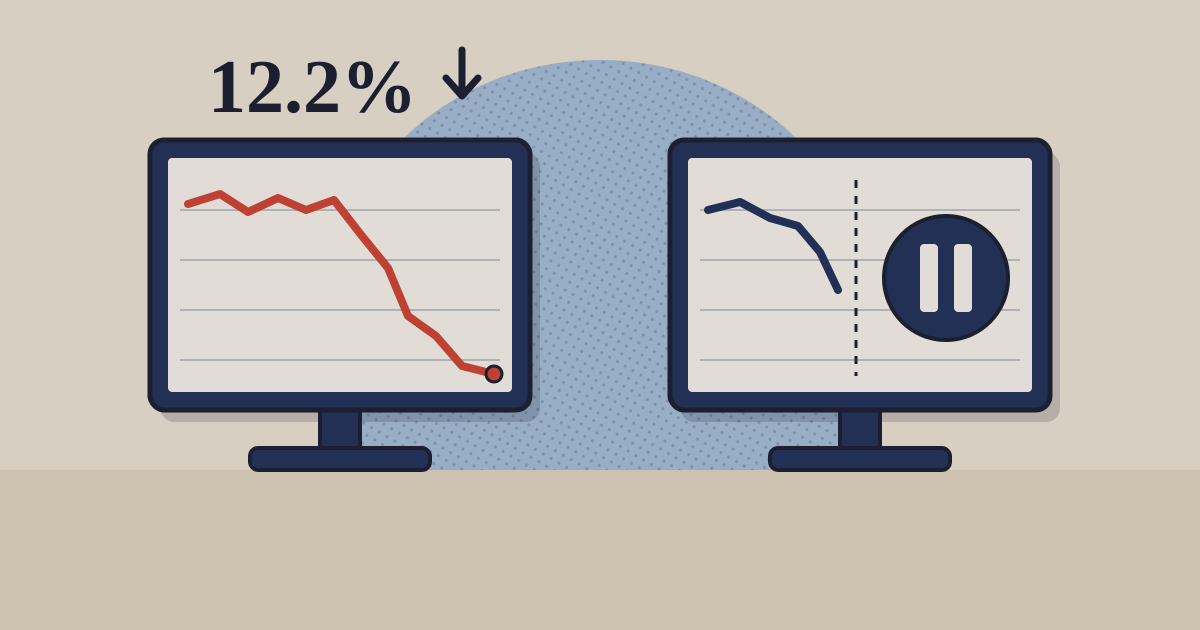
Taiwan’s TAIEX closed at 39,701.64 on Friday 6 November, down 1,873.08 points, or 4.5%, on the day and 12.2% on the week, from 45,211.83 on 30 October.12 It was the largest weekly fall of 2026 by the exchange’s own numbers, more than twice the next.3 In Seoul the same morning, the KOSPI fell more than 8% within minutes of the open and the Korea Exchange halted trading for 20 minutes from 9:03.10 It closed 6.02% lower at 5,059.69, a day after a 5.28% fall that followed the US local data-centre ballots, which we covered on 5 November.1112
Taiwan's index closed 20.3% below its 6 October high after a 12.2% week
TAIEX, daily close, points, 1 October to 6 November 2026
Show tableHide table
| TAIEX | |
|---|---|
| 1 Oct | 48,353 |
| 2 Oct | 48,476 |
| 5 Oct | 49,712 |
| 6 Oct | 49,823 |
| 7 Oct | 49,806 |
| 8 Oct | 49,313 |
| 12 Oct | 49,302 |
| 13 Oct | 48,341 |
| 14 Oct | 48,626 |
| 15 Oct | 46,970 |
| 16 Oct | 47,111 |
| 19 Oct | 46,822 |
| 20 Oct | 46,293 |
| 21 Oct | 46,888 |
| 22 Oct | 46,041 |
| 27 Oct | 46,096 |
| 28 Oct | 47,036 |
| 29 Oct | 46,368 |
| 30 Oct | 45,212 |
| 2 Nov | 44,920 |
| 3 Nov | 43,308 |
| 4 Nov | 42,949 |
| 5 Nov | 41,575 |
| 6 Nov | 39,702 |
Source: Taiwan Stock Exchange, Highlights of Daily Trading (FMTQIK), October and November 2026 · as of 6 November 2026 · the 20.3% and 12.2% falls are TechBag arithmetic on TWSE closes
01How far Taiwan fell, and what moved it
The index opened at 38,915.76 and touched 37,837.05, 3,737.67 points below Thursday’s close, before recovering.4 CNA called that the largest intraday point decline in the market’s history; on the close it was the fourth-largest single-day point loss.78 Nikkei Asia’s headline called it the steepest fall ever.14 In percent it was not: on 17 July the index closed 6.47% lower.3
TSMC, more than 40% of the market’s value, opened at NT$2,020, 9.8% down and at its daily limit, and closed 4.69% lower at NT$2,135, 9.9% below its 30 October close.58 Foreign investors sold a net NT$91.19bn of shares on Friday and NT$524.38bn over the week; domestic investment trusts bought a net NT$128.82bn.6 Dealers attributed the sell-off to losses on Wall Street and concern over possible restrictions on AI data-centre building after Democrats won both chambers of Congress and governorships including Texas.8 That evening the committee of the NT$500bn National Financial Stabilization Fund authorised its tenth market intervention since 2000, and the Financial Supervisory Commission encouraged listed companies to buy back shares and tightened stock borrowing for short selling.9
02How Korea's circuit breaker works
−6.02%
KOSPI, to 5,059.69, on 6 November
Yonhap
−8.8%
KOSPI at its low, 4,911.28
TechBag arithmetic on Yonhap
−10.44%
SK hynix, to ₩1.13 million
Yonhap
−6.35%
Samsung Electronics, to ₩188,700
Yonhap
The Korea Exchange’s rule has three stages. When the KOSPI stays more than 8% below the previous close for one minute, all trading in the KOSPI market and the futures and options linked to it stops for 20 minutes; orders can be cancelled but not placed. A second 20-minute halt follows at 15% if the index is also 1% below where the first began; at 20%, with the same extra 1%, trading ends for the day. Each stage can run once a day, and the first two not in the last 40 minutes of the session.13 Friday’s was the tenth activation this year, Yonhap reported.10 In Taipei, what stopped TSMC’s fall at the open was a limit on the single stock: 10%, the most a share may drop in a day.8
Foreign investors sold a net ₩2.8 trillion of KOSPI shares, Yonhap reported. Lee Kyoung-min of Daishin Securities attributed the fall to concern that Congress could tighten rules on AI data centres, called the reaction “excessive” and said a complete halt to data-centre construction was unlikely.11 The finance minister, Lee Hyoung-il, said the government was ready to act against swings unrelated to fundamentals.12
03What to watch
US markets reopen on Friday morning New York time, after the close in Taipei and Seoul. The stabilisation fund has authority to buy, but has not said how much or when.9 The fears behind both falls are about how much the largest companies will keep spending on data centres; that spending is tracked quarter by quarter in our Big Tech capex Trend.
Sources
- Taiwan Stock Exchange, Highlights of Daily Trading (FMTQIK), November 2026 — 6 November 2026
- Taiwan Stock Exchange, Highlights of Daily Trading (FMTQIK), October 2026 — 30 October 2026
- Taiwan Stock Exchange, Highlights of Daily Trading (FMTQIK), monthly tables December 2025 to September 2026 (July shown) — 31 December 2025 to 30 September 2026
- Taiwan Stock Exchange, TAIEX historical data (open, high, low, close), November 2026 — 6 November 2026
- Taiwan Stock Exchange, daily trading of 2330 (TSMC), October and November 2026 — 6 November 2026
- Taiwan Stock Exchange, trading value of foreign and other investors (BFI82U), 6 November and week of 2–6 November — 6 November 2026
- Focus Taiwan (CNA), Taiex plunges over 3,700 points in early trading as TSMC hits limit down — 6 November 2026
- Focus Taiwan (CNA), Taiex closes below 40,000 in 4th-largest single-day point loss — 6 November 2026
- Focus Taiwan (CNA), Stabilization fund ready for market intervention after Taiex's plunge — 6 November 2026
- The Korea Times (Yonhap), Trading of KOSPI stocks suspended amid tech sell-off — 6 November 2026
- Korea JoongAng Daily (Yonhap), Kospi falls for 2nd day on AI rout after U.S. midterms — 6 November 2026
- The Korea Times, Black Friday: KOSPI sinks 6%, extending slide on US AI regulation fears (Park Han-sol, Jun Ji-hye) — 6 November 2026
- Korea Exchange, Circuit Breakers in stock market (rules page) — current rules, undated
- Nikkei Asia, Taiwan stocks in steepest ever fall, South Korea halts trading amid AI rout (headline only; paywalled) — 6 November 2026
Disclosure. TechBag is a software reseller: it earns a margin when a reader buys through it, including from vendors named here. The analysis is TechBag’s own; no vendor paid for or saw this piece before publication. Facts are labelled reported, TechBag count or our view.
Keep reading